

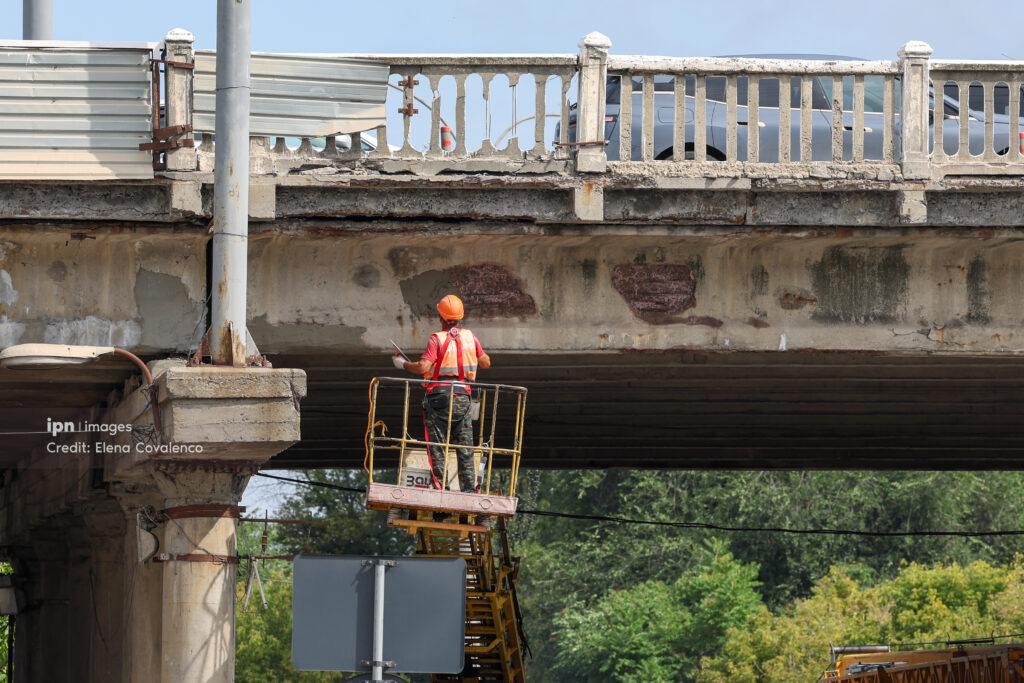
Chisinau City Hall and the EBRD have signed a pre-financing agreement for the rehabilitation of the Ismail Bridge

Chisinau City Hall and the European Bank for Reconstruction and Development have signed a pre-financing agreement for the rehabilitation of the bridge on Ismail Street in the capital. According to the municipal authorities, the bridge’s technical condition calls for extensive work to improve traffic safety, extend its service life and ease congestion, IPN reports.

The document was signed by Mayor Ion Ceban and Giuseppe Grimaldi, Head of the EBRD Office in Moldova. The mayor noted that the bridge, built in 1968, needs to be completely rebuilt to meet European standards.

“This is a major infrastructure project for the city of Chisinau. It needs to be completely rebuilt to European standards, and we will do this together,” said Ion Ceban.

For his part, Giuseppe Grimaldi noted that the project’s preparatory phase involves conducting technical and feasibility studies, providing construction supervision services, and reviewing the detailed engineering design. The documentation required to launch the procurement procedures for the construction works will then be prepared.

The project’s value is estimated at €10 million. The EBRD will provide a €700,000 grant to fund technical studies and preparatory work.


Two Ukrainian women have been detained on suspicion of smuggling more than 643,000 lei and US$50,500 into the Republic of Moldova. According to the Border Police, the women are believed to be part of a cash-smuggling ring operating between Ukraine and Moldova, IPN reports.

The incident was recorded in the town of Otaci, where law enforcement officers stopped a car driven by a Moldovan citizen for a routine check. The two women and another Moldovan citizen were also in the vehicle.

According to preliminary findings, the women had allegedly crossed the border earlier on foot at the Otaci border crossing, carrying 643,675 lei and US$50,500 without declaring the money to customs authorities.

The investigation is ongoing to establish the full circumstances of the case and identify anyone else who may be involved in the scheme.

0 FacebookTwitterPinterestEmail


Chisinau City Hall and the EBRD have signed a pre-financing agreement for the rehabilitation of the Ismail Bridge

Chisinau City Hall and the European Bank for Reconstruction and Development have signed a pre-financing agreement for the rehabilitation of the bridge on Ismail Street in the capital. According to the municipal authorities, the bridge’s technical condition calls for extensive work to improve traffic safety, extend its service life and ease congestion, IPN reports.

The document was signed by Mayor Ion Ceban and Giuseppe Grimaldi, Head of the EBRD Office in Moldova. The mayor noted that the bridge, built in 1968, needs to be completely rebuilt to meet European standards.

“This is a major infrastructure project for the city of Chisinau. It needs to be completely rebuilt to European standards, and we will do this together,” said Ion Ceban.

For his part, Giuseppe Grimaldi noted that the project’s preparatory phase involves conducting technical and feasibility studies, providing construction supervision services, and reviewing the detailed engineering design. The documentation required to launch the procurement procedures for the construction works will then be prepared.

The project’s value is estimated at €10 million. The EBRD will provide a €700,000 grant to fund technical studies and preparatory work.


Hungarian oil company MOL is seeking financial support from the European Union as part of the plan to phase out Russian oil imports by the end of 2027. The company’s management warns that the shift could drive up energy costs, triggering social tensions and political instability in Hungary and Slovakia, IPN reports.

In an interview with Euronews, MOL CEO György Bacsa stated that the group is technically prepared to move away from Russian oil, but requires European funding to develop alternative supply routes and expand infrastructure.

György Bacsa noted that financial and environmental restrictions on fossil fuel projects limit access to the European funding needed to develop infrastructure. He also proposed an EU-wide programme to interconnect gas, electricity, oil and petroleum product networks, citing the infrastructure gap between Central and Eastern Europe and Western Europe.

In this context, European Commission spokesperson Anna-Kaisa Itkonen said that fossil fuel infrastructure projects could be discussed, but the EU’s priority remains reducing its dependence on Russian energy.

The European Union began phasing out imports of Russian oil and liquefied natural gas this year. Pipeline gas imports are set to end by September 30, 2027, and crude oil imports by the end of that year at the latest.

According to a 2025 study by the International Monetary Fund, a complete halt to Russian crude oil supplies could increase Hungary’s energy costs by around 15% by 2030.

0 FacebookTwitterPinterestEmail


1 IANUARIE, 2025
1 IANUARIE, 2025