

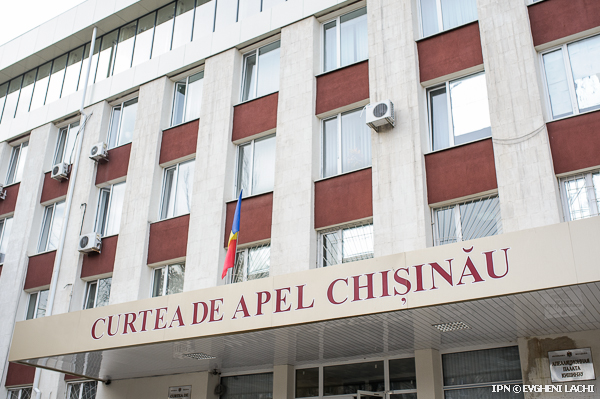
Appeals Court hearing in case of elections to start at 3pm

The appeal filed by the lawyers for Andrei Nastase following the Chisinau Court’s decision to not validate the election of Nastase as mayor of Chisinau was scheduled for June 21, 3pm.

Spokeswoman for the Chisinau Appeals Court Octeabrina Popa has told IPN that the case was distributed to judge a Vladislav Clima.

The Centru branch of the Court of Chisinau didn’t validate the local mayoral elections held in Chisinau on June 3 for the reason that both Andrei Nastase and Ion Ceban campaigned on the election day, which is inadmissible according to the Election Code. Both of the candidates, through the agency of live streams on social networking sites, called on the electorate to vote. Even if these didn’t say who namely the people should vote for, the court decided that these actions had a significant impact on the voters’ option.


The deputies of the Socialist Party have appealed to the Constitutional Court and are requesting a review of the constitutionality of the provision that allows the country’s president to decide on the dismissal of members of the Supervisory Board and the Executive Committee of the National Bank of Moldova, reports IPN.

According to the contested provision, the Parliament proposes the dismissal of the members of the BNM leadership, and the final decision belongs to the head of state. The rule was introduced through a modification adopted on April 2 and came into effect on April 23.

According to the new procedure, the legislative proposal is sent to the president within at most one working day, and he must pronounce himself within 30 days.

In the view of the socialist deputies, this provision unjustifiably expands the powers of the president and essentially grants him a veto right over a decision of the Parliament. They argue that such a competence is not provided for by the Constitution in the case of the BNM.

The authors of the complaint also draw attention to the fact that the law does not specify under what conditions the head of state can reject the Parliament’s proposal, what happens if they do not pronounce within the deadline, and whether the decision can be challenged in court. In their opinion, these ambiguities can generate conflicts of competence and legal unpredictability.

0 FacebookTwitterPinterestEmail


Appeals Court hearing in case of elections to start at 3pm

The appeal filed by the lawyers for Andrei Nastase following the Chisinau Court’s decision to not validate the election of Nastase as mayor of Chisinau was scheduled for June 21, 3pm.

Spokeswoman for the Chisinau Appeals Court Octeabrina Popa has told IPN that the case was distributed to judge a Vladislav Clima.

The Centru branch of the Court of Chisinau didn’t validate the local mayoral elections held in Chisinau on June 3 for the reason that both Andrei Nastase and Ion Ceban campaigned on the election day, which is inadmissible according to the Election Code. Both of the candidates, through the agency of live streams on social networking sites, called on the electorate to vote. Even if these didn’t say who namely the people should vote for, the court decided that these actions had a significant impact on the voters’ option.


The educational process conducted in Romanian in the Transnistrian region is severely affected by the lack of dedicated spaces. Schools carry out their activities in rented spaces, which do not fully meet the requirements of an educational institution, according to the reports of inspections carried out on August 24-25 by representatives of the Ministry of Education and Research and other institutions under the authority of constitutional authorities, reports IPN.

The Bureau of Reintegration Policy mentions in a press release that the preparedness of institutions for the academic year 2026-2027 has been evaluated, including in terms of education, health, food, and technical aspects.

BPR specifies that activity in improper or insufficiently adapted spaces limits the possibilities of arranging classrooms, food blocks, and sports fields. “Ensuring institutions with their own, suitable and safe premises remains a priority, this being an essential condition for the stable and qualitative conduct of the educational process,” the statement said.

According to the authorities, the development of the educational system in the Transnistrian region must be carried out in accordance with the provisions of the Education Code of the Republic of Moldova. It also needs to adhere to the national quality standards and principles of the European Education Area, including the standards of the Bologna Process, so that all children and young people in the region can benefit from quality, safe, and recognized studies.

0 FacebookTwitterPinterestEmail


1 IANUARIE, 2025
1 IANUARIE, 2025