

Moldova ranks second among EaP countries by press freedom

The press in the Republic of Moldova is partially free. With a score of 5 points of 7, the country ranks second among the EaP countries after Georgia, being followed by Armenia and Ukraine.

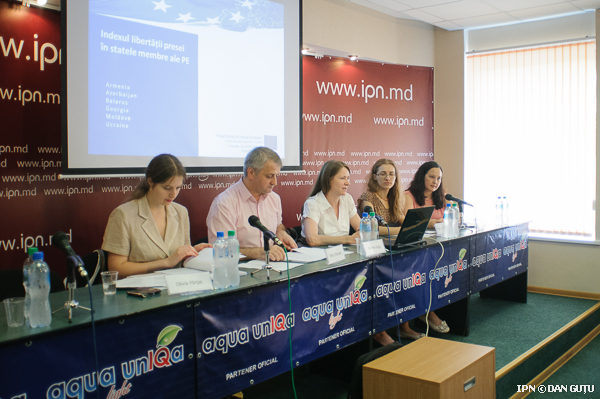
In a news conference at IPN, Independent Journalism Center director Nadine Gogu said the Press Freedom Index released on July 25 is a research undertaken by experts from six countries. It measures the press freedom degree in the countries of the Eastern Partnership. The project will last for two years. Each team of experts is analyzing the situation in their country.

The national Press Freedom Index was compiled based on the assessments of ten media experts from Moldova. Such studies will be made quarterly.

“The assessments referred only to the level of press freedom, not yet to the quality of the products. Every expert received a questionnaire that was filled out based on a score of 1 to 3. On the basis of these questionnaires, there were determined the country score and rating,” explained Nadine Gogu.

Olivia Pirtac, expert in media legislation, said the legal framework meets the international norms almost fully, but work is yet to be done to ensure the implementation of the adopted laws. “We have very good laws. The legal framework has been improved over the last few years,” he stated, adding that a factor that hinders press freedom is the lack of institutional independence and transparency as regards media ownership.

Editor-in-chief of the paper “Adevarul” (“Truth”) Alina Turcanu said that though access to information is free, the journalists see that the press is not fully free when they try to use these rights.

Association of Independent Press director Petru Macovei said the freedom in covering political events scored 10 points of 15. “The experts’ perception as regards the reform at the National Public Broadcaster “Teleradio-Moldova” is that it does not meet the expectations. We scored 1.9 points out of 3 possible,” he said, adding that the freedom of electronic media scored 11.5 points of 15, which is a rather good result.

The study reveals a series of shortcomings faced by Moldova, including inappropriate implementation of the national legislation, defective relation between the media and justice, state monopoly on the distribution of the press. The positive aspects include the development of new media and the right to freedom of expression.

nadine gogu despre proiect.mp3


Healthcare unionists in Romania announced on Friday the suspension of the general strike, three days after the protest began. The Sanitas Federation claims that the action has achieved an initial objective, after the Chamber of Deputies approved an amendment to the Health Law that allows for the unlocking of hiring for vacant positions, and the adoption of the new Salary Law has been postponed, IPN reports.

Sanitas representatives clarify that the suspension does not mean the end of the labor dispute, but a period of negotiation with the authorities for the development of a new salary law project. The unionists warn that if by August 31 a project negotiated with social partners is not registered in Parliament, the strike could be resumed. Until then, employees will wear armbands.

The general strike in the medical system was initiated on Tuesday and took place in several hundred medical institutions. During the protest action, only emergency services and complex medical cases were ensured.

0 FacebookTwitterPinterestEmail


Moldova ranks second among EaP countries by press freedom

The press in the Republic of Moldova is partially free. With a score of 5 points of 7, the country ranks second among the EaP countries after Georgia, being followed by Armenia and Ukraine.

In a news conference at IPN, Independent Journalism Center director Nadine Gogu said the Press Freedom Index released on July 25 is a research undertaken by experts from six countries. It measures the press freedom degree in the countries of the Eastern Partnership. The project will last for two years. Each team of experts is analyzing the situation in their country.

The national Press Freedom Index was compiled based on the assessments of ten media experts from Moldova. Such studies will be made quarterly.

“The assessments referred only to the level of press freedom, not yet to the quality of the products. Every expert received a questionnaire that was filled out based on a score of 1 to 3. On the basis of these questionnaires, there were determined the country score and rating,” explained Nadine Gogu.

Olivia Pirtac, expert in media legislation, said the legal framework meets the international norms almost fully, but work is yet to be done to ensure the implementation of the adopted laws. “We have very good laws. The legal framework has been improved over the last few years,” he stated, adding that a factor that hinders press freedom is the lack of institutional independence and transparency as regards media ownership.

Editor-in-chief of the paper “Adevarul” (“Truth”) Alina Turcanu said that though access to information is free, the journalists see that the press is not fully free when they try to use these rights.

Association of Independent Press director Petru Macovei said the freedom in covering political events scored 10 points of 15. “The experts’ perception as regards the reform at the National Public Broadcaster “Teleradio-Moldova” is that it does not meet the expectations. We scored 1.9 points out of 3 possible,” he said, adding that the freedom of electronic media scored 11.5 points of 15, which is a rather good result.

The study reveals a series of shortcomings faced by Moldova, including inappropriate implementation of the national legislation, defective relation between the media and justice, state monopoly on the distribution of the press. The positive aspects include the development of new media and the right to freedom of expression.

nadine gogu despre proiect.mp3

The Chisinau municipal council has approved the Local Action Plan for greener mobility, a document drawn up by the General Directorate of Architecture, Urban Planning and Land Relations. It provides for the classification of the streets in the capital and will serve as a guide for future interventions on the street space, reports IPN.

The interim deputy head of the General Directorate of Architecture, Mihaela Sultan, mentioned that the plan is based on three main directions: the redevelopment of streets, changing the mode of transportation and strengthening institutional support for the development of sustainable urban mobility.

The document proposes the reorganization of street space to create better conditions for pedestrians, cyclists and public transportation, as well as new design principles for future interventions. It includes seven categories of streets: main transit arteries, streets dedicated to public transportation, central streets, main neighborhood streets, residential streets, pedestrian streets and industrial streets.

The plan was developed within the framework of the European project CityWalk 2.0, funded by the European Union. The document is complementary to the Sustainable Urban Mobility Plan of the municipality of Chisinau.

0 FacebookTwitterPinterestEmail


1 IANUARIE, 2025
1 IANUARIE, 2025