

Why did number of students in universities decrease? Analysis

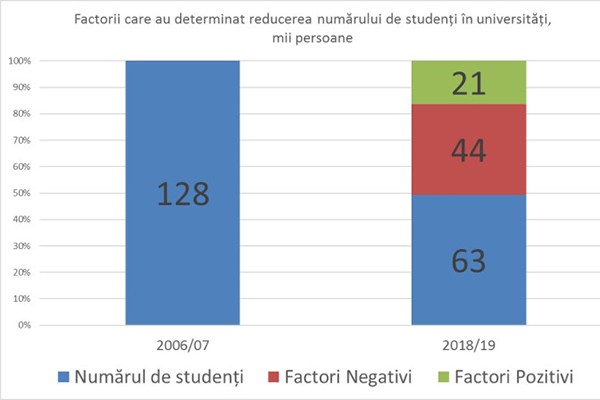
The number of students during the past 12 years has halved, from 128,000 in 2006-2007 to 63,000 in the 2018-2019 academic year, expert of the Institute for Development and Social Initiative “Viitorul” Veaceslav Ionita says in an analysis to which IPN makes reference.

According to the expert, the reduction is due to two groups of factors. The first group consists of such negative factors as the demographic evolutions, lower birth rate and migration. These led to a 2/3 reduction in the number of students, which is a decline of 42,000-45,000 persons, and to a decrease of over 130,000 in the number of children during the past 10-12 years. Consequently, the lack of children generated a lack of students.

The second group, of positive factors, led to a 1/3 reduction in the number of students, which is a decline of 20,000-23,000 persons. Even if the number of students decreased considerably due to these factors, they are considered positive. These include the improvement of the Baccalaureate examination process and the switchover to the two-level university education system.

According to Veaceslav Ionita, the improvement in the Baccalaureate examination process reduced the number of students in universities by about 5,000. The universities that were in pursuit of contracts eliminated any admission filter and accepted everyone as their students. The admission rate was close to 100%, which is illogical. The Baccalaureate exams became the filer that substituted the lack of selection at universities. Some 80-95% of the students who pass the Baccalaureate exams go to study at a university. So, the Baccalaureate exam became a kind of admission exam at universities.

The expert noted the switchover to the two-level university system solved another problem of higher education, namely the exam pass rate. Wishing not to lose the contracts with students, the universities ensured an exam pass rate of almost 100% even if some of the students could be absent. This turned the higher education into an orchard for growing diplomas. The institution of the two-level system became another filter that helps select the students. Thus, only 30-40% of the students who complete the first cycle of university education decide to continue their studies.

Veaceslav Ionita noted the positive factors created two administrative filters by which up to 23,000 students are excluded. These filters replace the complete lack of selection filters at universities. If these two filters hadn’t existed, we could have said that the university education in Moldova perished.


The former president of the Banca de Economii, Grigore Gacikevici, was detained on Wednesday in a case where he is being investigated for large-scale money laundering. Today, the court is expected to pronounce the sentence in another case, in which he is accused of granting non-performing loans that allegedly caused the Banca de Economii a damage of approximately three billion lei, reports IPN.

According to the National Anticorruption Center, during his tenure at the bank, Gacikevici allegedly received illicit remuneration for facilitating the granting of loans, and subsequently transferred money abroad, originating from criminal activity. He was placed in the CNA isolation ward for 72 hours.

In the case of non-performing loans, the former head of BEM is on trial alongside four former members of the bank’s lending committee. Prosecutors allege that between 2005 and 2012, they approved loans in violation of internal rules and banking prudence rules.

According to the accusation, the loans would have been granted without the proper assessment of the repayment capacity, based on incomplete files and without sufficient verification of the beneficiaries. Also, in some cases, the guarantees would have been insufficiently evaluated or monitored.

The prosecutors have requested 15 years of imprisonment for Grigore Gacikevici and 13 years each for the other four defendants, as well as the recovery of the estimated damage of approximately three billion lei.

0 FacebookTwitterPinterestEmail


Why did number of students in universities decrease? Analysis

The number of students during the past 12 years has halved, from 128,000 in 2006-2007 to 63,000 in the 2018-2019 academic year, expert of the Institute for Development and Social Initiative “Viitorul” Veaceslav Ionita says in an analysis to which IPN makes reference.

According to the expert, the reduction is due to two groups of factors. The first group consists of such negative factors as the demographic evolutions, lower birth rate and migration. These led to a 2/3 reduction in the number of students, which is a decline of 42,000-45,000 persons, and to a decrease of over 130,000 in the number of children during the past 10-12 years. Consequently, the lack of children generated a lack of students.

The second group, of positive factors, led to a 1/3 reduction in the number of students, which is a decline of 20,000-23,000 persons. Even if the number of students decreased considerably due to these factors, they are considered positive. These include the improvement of the Baccalaureate examination process and the switchover to the two-level university education system.

According to Veaceslav Ionita, the improvement in the Baccalaureate examination process reduced the number of students in universities by about 5,000. The universities that were in pursuit of contracts eliminated any admission filter and accepted everyone as their students. The admission rate was close to 100%, which is illogical. The Baccalaureate exams became the filer that substituted the lack of selection at universities. Some 80-95% of the students who pass the Baccalaureate exams go to study at a university. So, the Baccalaureate exam became a kind of admission exam at universities.

The expert noted the switchover to the two-level university system solved another problem of higher education, namely the exam pass rate. Wishing not to lose the contracts with students, the universities ensured an exam pass rate of almost 100% even if some of the students could be absent. This turned the higher education into an orchard for growing diplomas. The institution of the two-level system became another filter that helps select the students. Thus, only 30-40% of the students who complete the first cycle of university education decide to continue their studies.

Veaceslav Ionita noted the positive factors created two administrative filters by which up to 23,000 students are excluded. These filters replace the complete lack of selection filters at universities. If these two filters hadn’t existed, we could have said that the university education in Moldova perished.


Why did number of students in universities decrease? Analysis

The Moldovan national team kicked off with a victory at the European Beach Football Championship. The Tricolors defeated the Kazakhstan...

Acest material este disponibil doar pe bază de abonament.
Abonează-te pentru a avea acces la mai multe materiale și funcționalități exclusive!

0 FacebookTwitterPinterestEmail


1 IANUARIE, 2025
1 IANUARIE, 2025