

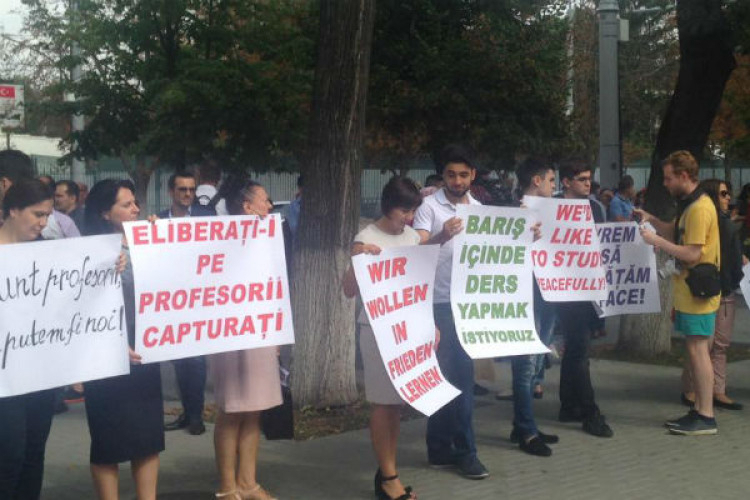
Five years since expulsion of Turkish teachers. Promo-LEX: Late justice and unfulfilled promises

It has been five years of the illegal expulsion of Turkish teachers the criminal cases against some of which are being examined in appeals courts in Turkey, while others were already set free, but are in Turkey as they cannot leave the country to reunite with their families that live in Moldova too, said experts of Promo-LEX Association, who reiterated their call to the authorities to make serious efforts to discover the truth about this case and to fully investigate, under adequate public control, the possible involvement of any public figure holding high ranking posts, IPN reports.

After Moldova was convicted by the European Court of Human Rights, the Committee of Ministers of the Council of Europe issued four decisions concerning the execution of the decision in the case of Ozdil and others, by which the Moldovan authorities were requested to take more individual and general measures. Representatives of the Legal Resources Center from Moldova and of Promo-LEX Association remitted several communications on this case to the committee of Ministers.

In the last case examination session on December 6-8, 2022, the Committee of Minister welcomed the authorities’ decision to declassify material of the criminal case started against the former head of the Security and Intelligence Service Vasile Botnari and another 14 documents related to the given events. The Committee encouraged again the authorities to take into account the necessity of transmitting a clear message, from the highest political level, about the absolutely inacceptable character and zero tolerance of arbitrary detention and extralegal transfers. The Committee invited the authorities to provide information about all the aspects mentioned earlier by October 31, 2023.

The criminal case concerning the expulsion of Turkish teachers continues being tried in Moldova. In February, the Chisinau Appeals Court accepted the complaint submitted by Galina Tufekci, the wife of one of the Turkish teachers, annulling an order of 2020 by which she was illegally and abusively stripped of the status of injured party and requesting the Chisinau Prosecutor’s Office to deal with the violations of her rights in a specific case. In her name and in the name of her husband, Galina Tufekci challenged this decision in the Supreme Court of Justice. The case is pending.

It was ascertained that the Prosecutor General’s Office doesn’t conduct investigations in the other criminal cases related to the Turkish citizens. “Despite the statements and promises made by a number of politicians, some of whom are now in power, nothing was done to ease the situation of the Turkish citizens who are in detention. When officials of the Government and Parliament of the Republic of Moldova paid visits to Turkey, the situation of the Turkish teachers hasn’t been even raised,” said Promo-LEX.

The Association calls on the authorities to further obtain detailed information from the Turkish authorities about the current situation of the plaintiffs in Turkey and about the possibility of applying the Council of Europe Convention on the Transfer of Sentenced Persons.

The seven foreign citizens – teachers and managers of the Orizont network of lyceums – were declared undesirable and expelled on September 6, 2018. The expelled citizens were convicted in Turkey. On June 11, 2019, the ECHR ascertained that the Republic of Moldova violated the rights of the seven Turkish citizens and obliged the state to pay by €25,000 to five Turkish citizens. The former SIS director Vasile Botnari was given a suspended sentence and was only fined 88,000 lei.


A history lesson for the generation that has the duty to bring the Union to completion

In the history of all nations, there are moments when the political direction is preceded by a deeper change, almost invisible at first: the change of consciousness. States are born through political acts, but nations are consolidated through culture, education, memory and intellectual elites. Modern Romania represents one of the most eloquent examples in this regard. Long before the Union of the Principalities in 1859 or the Great Union in 1918, there was a cultural Romania, built through the common language, through school, through literature, through the church, through historiography and through the discreet but tireless work of intellectuals.

The publication, on May 5, 2026, of the Romanian Academic Council’s Appeal to public authorities, the intellectual community and Romanian society on both banks of the Prut, brings back into focus precisely this fundamental lesson of history. It is not just an institutional document, nor a simple statement of principle. It is a reaffirmation of the role that intellectuals play in the great turning points of a nation’s destiny – and, more than that, a signal that the time for preparations is nearing its end and the time for decision is approaching its beginning.

Established on March 26, 2026, by the merger of the Romanian Academy, the Academy of Sciences of Moldova, and four branch academies from Romania, the Romanian Academic Council represents, probably, the most important institutional formula of Romanian academic cooperation since 1991. It did not appear by chance at a time when the Republic of Moldova is going through the most important stage of its European journey and the war in Ukraine has radically changed the security architecture in Eastern Europe.

Great national projects are not born in the offices of politicians

There is a tendency to attribute major historical transformations exclusively to political leaders. In reality, politics consecrates what society and culture have been preparing for decades.

The unification of the Principalities would not have been possible without the 1848 generation. Greater Romania would not have existed without the Transylvanian school, without Mihail Kogalniceanu, without Nicolae Iorga, without Titu Maiorescu, without Mihai Eminescu and without the thousands of teachers, priests, educators, and cultural figures who cultivated the consciousness of belonging to the same historical community. They did not have electoral mandates and did not sign treaties. Instead, they had something more durable: the conviction that a people separated by artificial borders remains, in essence, one.

The political Romania was preceded by the cultural Romania. And today, a century later, the same sequence is repeating before our eyes, this time on both banks of the Prut.

This idea, reaffirmed in the joint declaration of the Romanian Academy and the Academy of Sciences of Moldova from December 30, 2025, and now reiterated by the Romanian Academic Council, is not just a historical evocation. It expresses an almost universal rule: lasting political unity can only exist when it is preceded by the unity of values, language, education and collective memory.

From this perspective, the Appeal of the Romanian Academic Council is profoundly realistic. It does not ask for spectacular gestures or hasty decisions. On the contrary, it proposes exactly what is often missing from the public space: expertise, planning, research and institutional construction — the necessary but often ignored steps of any lasting unification process.

Intellectuals have the duty to tell the truth when politics hesitate

In moments of crisis, the responsibility of the intellectual is not to engage in partisan politics, but to defend the truth — including when the truth is inconvenient for those who prefer endless procrastination.

Academies, universities and research institutions should not replace the democratic decision of citizens. But they have the moral and professional obligation to create the framework in which society can make informed decisions, without manipulation and without falsifying the past. The silence of the elites, in the face of ambiguity deliberately maintained by some political actors, is not neutrality – it is a form of complicity with uncertainty. This is perhaps the most important message of the Appeal.

The Romanian Academic Council explicitly states that major decisions regarding the future of the Republic of Moldova belong to its citizens. However, before a democratic decision can be made, a space for knowledge must be constructed. And this construction can only be achieved through research, education and public dialogue.

In recent decades, the Republic of Moldova has been the battleground of a constant confrontation between historical truth and identity propaganda. Precisely for this reason, the role of the academic community becomes essential. When history is manipulated, when identity is relativized, when memory is used as a political tool, intellectuals no longer have the right to neutrality.

They have the duty to defend the documented truth. Not through slogans. Not through emotion. But through arguments. And, also through arguments, they have the duty to show where this truth naturally leads: to the recognition of a single historical and linguistic identity, beyond the administrative border imposed in 1812 and artificially maintained by successive empires.

From symbols to concrete projects

Another merit of the document lies in the fact that it shifts the discussion from the symbolic register to the institutional one.

For years, the closeness between Romania and the Republic of Moldova has been expressed almost exclusively through political statements and commemorative events. All of these have had their importance, but they are not enough for the construction of a lasting convergence — and, even less so, for the preparation of the political union that historical logic demands.

The Romanian Academic Council proposes the establishment of mixed groups of experts to develop studies on the harmonization of educational systems, the development of common research infrastructure, the alignment of the legal framework, the valorization of cultural heritage and the formulation of a common communication strategy. This is the difference between an ideal and a project.

History demonstrates that no major integration process can succeed without an intellectual and institutional foundation. The European Union itself is the result of an academic, legal, and economic construction elaborated over decades before political decisions.

The same principle applies to the relationship between Romania and the Republic of Moldova – with one essential difference: here it is not about the union of different states, but about the reunification of a single people, separated by a border that history has never morally validated.

Culture is the strongest form of security

In the current context, dominated by informational warfare and geopolitical competition, culture is no longer just a spiritual heritage. It becomes a tool of national security – and, in the case of the Republic of Moldova, a shield against a hybrid aggression targeting exactly what the Academies’ Appeal defends: language, history and collective consciousness.

A society that knows its history is harder to manipulate. A society that respects its language is harder to divide. A society that invests in education is more resistant to propaganda.

From this perspective, the academic closeness between Bucharest and Chisinau goes beyond the cultural dimension. It contributes to strengthening the democratic resilience of the entire Romanian space and prepares, step by step, the ground for the political act of rehabilitating the truth and logic of history.

Not by chance, the Romanian Academic Council speaks about the development of a common infrastructure for research, education and innovation. In the 21st century, a nation’s competitiveness no longer depends exclusively on natural resources or military capacity, but also on the strength of its academic institutions and the level of intellectual capital.

Union is not nostalgia, but a strategic necessity

It is important to underline: speaking about unification today does not mean looking back to the past, but responding to a concrete need of the present. In a region threatened by war, misinformation and economic instability, the full integration of the Republic of Moldova into the Romanian space – and through it, into the European Union – is not just an identity project, but a guarantee of security and prosperity for the citizens of both banks of the Prut.

The postponement of this process, under the pretext of “prudence”, risks leaving the Republic of Moldova exposed exactly to those vulnerabilities that the Romanian Academic Council identifies: historical manipulation, identity erosion, and dependence on narratives foreign to Romanian national interests. Prudence makes sense when it prepares the decision; it becomes complicity when it indefinitely delays it.

A historical responsibility of today’s generation

The appeal of the Romanian Academic Council conveys, in essence, a simple message, but of profound historical significance: the current generation cannot live solely on the inheritance of its ancestors, but has the obligation to make its own contribution to the fulfillment of the historical destiny of the Romanian people. In the context of the year 2026, this contribution involves assuming and completing the national project started with the Union of the Principalities in 1859, perfected through the Great Union in 1918, but fractured following the annexation of Bessarabia by the Soviet Union in 1940.

Over a century ago, the Romanian intelligentsia prepared the ground for the great political acts that made possible the construction of the unitary national state. Today, in a different geopolitical context, the same responsibility falls on the shoulders of academics, professors, researchers, writers, artists and all those who shape the public space through knowledge, culture and education. However, for this effort to produce historical effects, it must be accompanied by the political will of those called to govern the two Romanian states.

Therefore, the responsibility of the new governments in Bucharest and Chisinau is one that goes beyond the current administration of public affairs. They are called to transform the message of the Romanian Academic Council into a strategic direction of action, consolidating the common space of education, culture, research, infrastructure, economy and security. This is not about a conjunctural or partisan project, but about assuming a historical responsibility towards the generations that made modern Romania possible and towards those that will follow.

History does not demand the mechanical repetition of the past, but the understanding of its lessons. And the most important of these is that great political constructions only endure when they are founded on an authentic community of values, culture and national consciousness. Precisely for this reason, the principle reaffirmed in the Appeal of the Romanian Academic Council – that cultural Romania preceded political Romania – represents not only a historical observation, but also a direction of action for the present.

If the new governments in Bucharest and Chisinau will have the wisdom and courage to consider this appeal as a benchmark of their public policies, and if the academic institutions, intellectuals and civil society on both banks of the Prut will continue to strengthen the community of language, culture and historical memory, then the closeness between Romania and the Republic of Moldova will surpass the limits of political conjunctures. It will have the most durable foundation that history can offer: truth, culture, education and the consciousness of belonging to the same nation. And on this foundation, the restoration of Romanian national unity will no longer represent just a historical ideal, but the natural consequence of a convergence process assumed with responsibility by the elites and political factors of the two Romanian states.

0 FacebookTwitterPinterestEmail


Five years since expulsion of Turkish teachers. Promo-LEX: Late justice and unfulfilled promises

It has been five years of the illegal expulsion of Turkish teachers the criminal cases against some of which are being examined in appeals courts in Turkey, while others were already set free, but are in Turkey as they cannot leave the country to reunite with their families that live in Moldova too, said experts of Promo-LEX Association, who reiterated their call to the authorities to make serious efforts to discover the truth about this case and to fully investigate, under adequate public control, the possible involvement of any public figure holding high ranking posts, IPN reports.

After Moldova was convicted by the European Court of Human Rights, the Committee of Ministers of the Council of Europe issued four decisions concerning the execution of the decision in the case of Ozdil and others, by which the Moldovan authorities were requested to take more individual and general measures. Representatives of the Legal Resources Center from Moldova and of Promo-LEX Association remitted several communications on this case to the committee of Ministers.

In the last case examination session on December 6-8, 2022, the Committee of Minister welcomed the authorities’ decision to declassify material of the criminal case started against the former head of the Security and Intelligence Service Vasile Botnari and another 14 documents related to the given events. The Committee encouraged again the authorities to take into account the necessity of transmitting a clear message, from the highest political level, about the absolutely inacceptable character and zero tolerance of arbitrary detention and extralegal transfers. The Committee invited the authorities to provide information about all the aspects mentioned earlier by October 31, 2023.

The criminal case concerning the expulsion of Turkish teachers continues being tried in Moldova. In February, the Chisinau Appeals Court accepted the complaint submitted by Galina Tufekci, the wife of one of the Turkish teachers, annulling an order of 2020 by which she was illegally and abusively stripped of the status of injured party and requesting the Chisinau Prosecutor’s Office to deal with the violations of her rights in a specific case. In her name and in the name of her husband, Galina Tufekci challenged this decision in the Supreme Court of Justice. The case is pending.

It was ascertained that the Prosecutor General’s Office doesn’t conduct investigations in the other criminal cases related to the Turkish citizens. “Despite the statements and promises made by a number of politicians, some of whom are now in power, nothing was done to ease the situation of the Turkish citizens who are in detention. When officials of the Government and Parliament of the Republic of Moldova paid visits to Turkey, the situation of the Turkish teachers hasn’t been even raised,” said Promo-LEX.

The Association calls on the authorities to further obtain detailed information from the Turkish authorities about the current situation of the plaintiffs in Turkey and about the possibility of applying the Council of Europe Convention on the Transfer of Sentenced Persons.

The seven foreign citizens – teachers and managers of the Orizont network of lyceums – were declared undesirable and expelled on September 6, 2018. The expelled citizens were convicted in Turkey. On June 11, 2019, the ECHR ascertained that the Republic of Moldova violated the rights of the seven Turkish citizens and obliged the state to pay by €25,000 to five Turkish citizens. The former SIS director Vasile Botnari was given a suspended sentence and was only fined 88,000 lei.


Five years since expulsion of Turkish teachers. Promo-LEX: Late justice and unfulfilled promises

Canoeist Mihai Chihaia has won the bronze medal in the single canoe 1,000 meters event at the U-23 World Championship,...

Acest material este disponibil doar pe bază de abonament.
Abonează-te pentru a avea acces la mai multe materiale și funcționalități exclusive!

0 FacebookTwitterPinterestEmail


1 IANUARIE, 2025
1 IANUARIE, 2025