

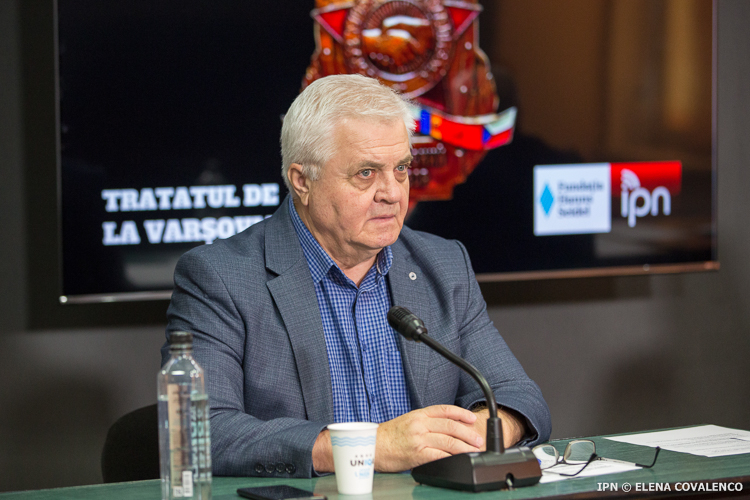
Anatol Țăranu: Warsaw Treaty was nothing else but “collective policeman”

The objectives for joining the Warsaw Treaty were hidden in the interests pursued by the Soviet Union in its spheres of influence and the confrontation with NATO was the propaganda coverage for expalining why this treaty was needed, doctor of history Anatol Țăranu, ex-ambassador of the Republic of Moldova to Russia, stated in a public debate hosted by IPN.

According to the historian, the objective of the treaty was to create a powerful military branch that could be used in time to extend socialism outside the socialist camp existing at that moment. In essence, the Warsaw Pact was nothing but a “collective policeman” whose duty was to maintain the Soviet domination in the Soviet Union’s geopolitical sphere created after World War II. This became clear when the Warsaw Pact intervened in the events in Hungary in 1956, even if mostly military units of the Soviet Union acted then. But in 1968 already, this “collective policeman” fully manifested itself during the Prague Spring. Its duty was also to keep close, in one community, the socialist states so that they didn’t deviate from the general course dictated by Moscow. Initially, the treaty included all the socialist states of Europe, except for Yugoslavia.

The doctor of history noted that the Berlin events of 1951 showed that the Soviet Union, in socialist Europe, was under strain. That’s why the main goal pursued by the USSR through the Warsaw Treaty was to strengthen its dominance in the influence zone in Europe, including through military methods, and this goal was achieved. “Unlike NATO, which never stipulated the goal of intervening in the sovereignty of its member states in the constituent documents, the goal of the Warsaw Pact was to limit the sovereignty of the states that entered the Soviet Union’s sphere of influence. The Soviets realized rather well that NATO didn’t pose a direct threat to the Soviet Union. The direct threat was that the socialist countries could separate themselves and this ultimately happened,” stated Anatol Țăranu.

In the same connection, the historian said the Soviet Union always vehemently denied the existence of the Brezhnev Doctrine, but there were a number of indirect proofs that confirmed its existence. The notion “Brezhnev Doctrine” appeared in 1968, after the invasion of Czechoslovakia, when Brezhnev met with representatives of the Czech administration. He then made it clear that the Soviet Union would intervene whenever there would be a danger to the Soviet interests in the Socialist states.

Anatol Țăranu also said that the existence of NATO is what enables Ukraine to exist and does not allow imperial Russia to extend its influence over zones in Europe in an uncontrolled way. “NATO survived, while the Warsaw Pact collapsed as the latter was nothing but a political-military system based on a failed economy that didn’t resist the competition of the capitalist economy,” stated the expert.

The public debate entitled “Warsaw Pact: History without propaganda” was the 20th installment of IPN’s project “Impact of the Past on Confidence and Peace Building Processes” which is supported by the Hanns Seidel Foundation of Germany.


Prime Minister Vasile Tofan will make his first official visit abroad since taking office on Thursday. The Premier will go to Romania, where he will be received at the Victoria Palace by his acting counterpart, Ilie Bolojan, reports IPN.

According to a government statement, the two officials will discuss strategic projects of common interest, with a direct impact on the citizens on both sides of the Prut, economic cooperation and security developments in the region. The meeting will be followed by press statements.

During the visit, Vasile Tofan will also meet with the President of Romania, Nicusor Dan, as well as with the representatives of the leadership of the Parliament in Bucharest. Additionally, the Prime Minister will have a discussion with the representatives of the Basarabeni Businessmen’s Club, focused on attracting investments and supporting the business environment.

0 FacebookTwitterPinterestEmail


Anatol Țăranu: Warsaw Treaty was nothing else but “collective policeman”

The objectives for joining the Warsaw Treaty were hidden in the interests pursued by the Soviet Union in its spheres of influence and the confrontation with NATO was the propaganda coverage for expalining why this treaty was needed, doctor of history Anatol Țăranu, ex-ambassador of the Republic of Moldova to Russia, stated in a public debate hosted by IPN.

According to the historian, the objective of the treaty was to create a powerful military branch that could be used in time to extend socialism outside the socialist camp existing at that moment. In essence, the Warsaw Pact was nothing but a “collective policeman” whose duty was to maintain the Soviet domination in the Soviet Union’s geopolitical sphere created after World War II. This became clear when the Warsaw Pact intervened in the events in Hungary in 1956, even if mostly military units of the Soviet Union acted then. But in 1968 already, this “collective policeman” fully manifested itself during the Prague Spring. Its duty was also to keep close, in one community, the socialist states so that they didn’t deviate from the general course dictated by Moscow. Initially, the treaty included all the socialist states of Europe, except for Yugoslavia.

The doctor of history noted that the Berlin events of 1951 showed that the Soviet Union, in socialist Europe, was under strain. That’s why the main goal pursued by the USSR through the Warsaw Treaty was to strengthen its dominance in the influence zone in Europe, including through military methods, and this goal was achieved. “Unlike NATO, which never stipulated the goal of intervening in the sovereignty of its member states in the constituent documents, the goal of the Warsaw Pact was to limit the sovereignty of the states that entered the Soviet Union’s sphere of influence. The Soviets realized rather well that NATO didn’t pose a direct threat to the Soviet Union. The direct threat was that the socialist countries could separate themselves and this ultimately happened,” stated Anatol Țăranu.

In the same connection, the historian said the Soviet Union always vehemently denied the existence of the Brezhnev Doctrine, but there were a number of indirect proofs that confirmed its existence. The notion “Brezhnev Doctrine” appeared in 1968, after the invasion of Czechoslovakia, when Brezhnev met with representatives of the Czech administration. He then made it clear that the Soviet Union would intervene whenever there would be a danger to the Soviet interests in the Socialist states.

Anatol Țăranu also said that the existence of NATO is what enables Ukraine to exist and does not allow imperial Russia to extend its influence over zones in Europe in an uncontrolled way. “NATO survived, while the Warsaw Pact collapsed as the latter was nothing but a political-military system based on a failed economy that didn’t resist the competition of the capitalist economy,” stated the expert.

The public debate entitled “Warsaw Pact: History without propaganda” was the 20th installment of IPN’s project “Impact of the Past on Confidence and Peace Building Processes” which is supported by the Hanns Seidel Foundation of Germany.


The Hydrometeorological Service in the Transnistrian region has established a yellow and orange hydrological danger code on the Dniester, valid from July 29 to August 7, due to the decrease in water level. According to the administration in Tiraspol, the orange code indicates “an increased risk of producing effects with significant impact”, reports the IPN correspondent from the Transnistrian region.

The decision comes after Chisinau extended until July 31 the hydrological warning regarding the reduced flow of the Nistru and other rivers. The yellow code is in effect in the Naslavcea-Dubasari sector, while between Dubasari and Tudora the orange code is maintained, where the water flow represents only 25-30% of the multiannual average.

In the context of the low level of the Nistru, the Government of the Republic of Moldova has instituted a hydrological alert for 30 days. The measure allows for quick interventions to manage water consumption and protect supply sources, so that drinking water for the population, medical institutions, and social ones remains a priority.

According to the Ministry of Environment, the reduction in the flow of the Nistru is caused by the lack of precipitation and unfavorable hydrometeorological conditions, with the risk of affecting the water intake structures and the water supply in the localities dependent on the river.

0 FacebookTwitterPinterestEmail


1 IANUARIE, 2025
1 IANUARIE, 2025