

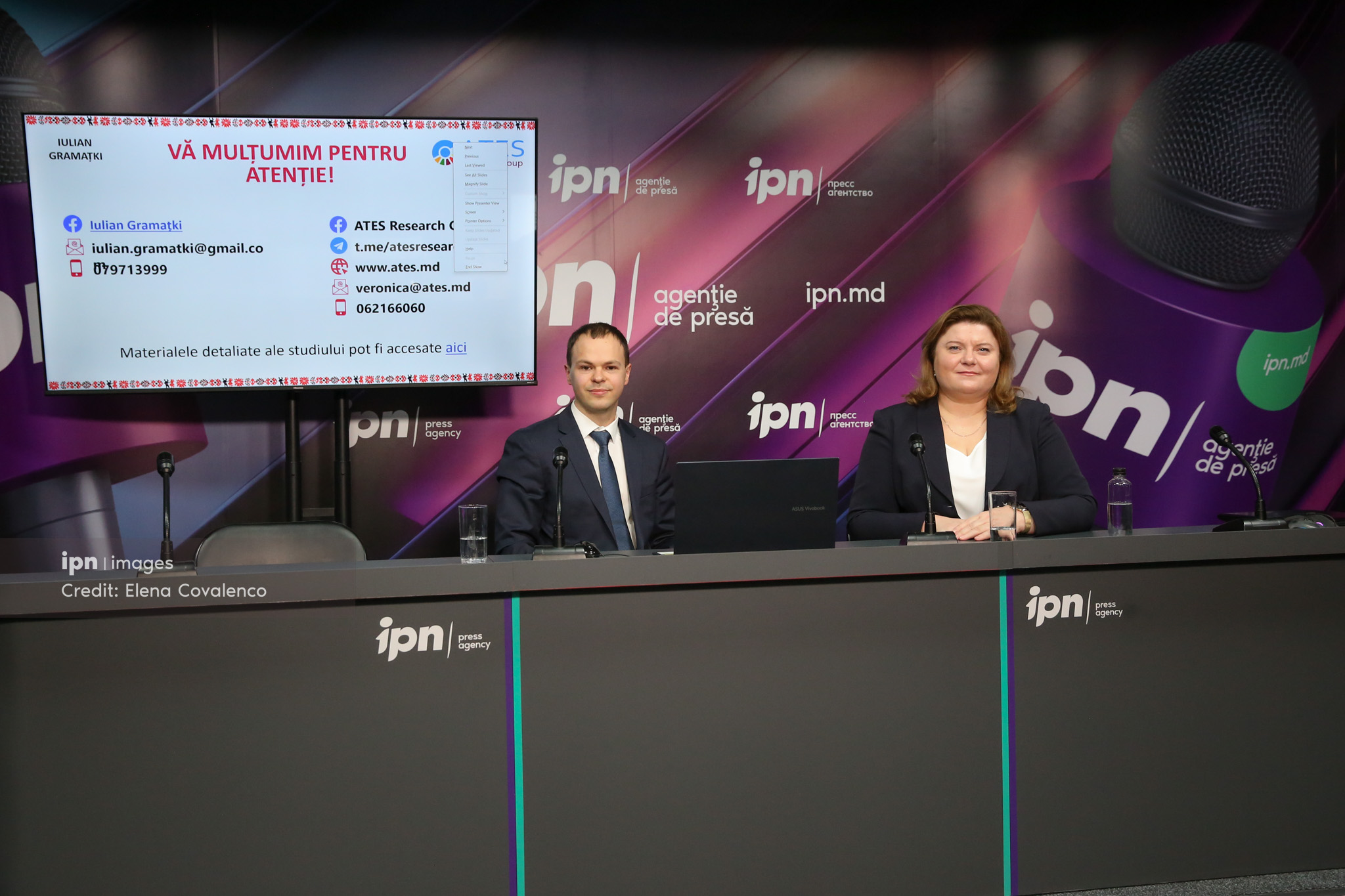
44% of the country’s citizens would vote for unification with Romania. In the diaspora, the support is greater

If a referendum on the unification of the Republic of Moldova with Romania were to take place next Sunday, 44% of the citizens on the country’s territory would vote “for”, while 39.2% would pronounce “against”. In the diaspora, support for unification is higher: almost 61% would vote “for”, and just over 24% would oppose. The data is contained in a sociological study conducted by the ATES research group.

In a press conference at IPN, Iulian Gramatki, an independent socio-economic researcher and initiator of the study, stated that the results contradict the common perception that the population would not support the idea of unification. “We see a relative majority of those who would vote in favor of unification. Countering these perceptions by providing such data is one of the basic purposes of this study,” the researcher affirms.

The respondents were also asked whether the unification of the Republic of Moldova with Romania would bring more advantages or disadvantages. In the Republic of Moldova, 37% believe that there would be more advantages, while 33.3% think that the disadvantages would prevail. In the diaspora, an absolute majority of over 52% indicated that the unification would bring benefits. Among the most frequently mentioned advantages are wage and pension increases, access to jobs, and economic development.

In terms of potential risks, the most frequently cited disadvantage is the loss of sovereignty and independence, followed by possible interethnic tensions and the deterioration of economic relations with Russia and the CIS states. These concerns were mentioned by respondents both in the country and in the diaspora.

The study data shows that the majority of respondents believe that the union should be decided by referendum. Approximately 44% of participants from the country indicated this option, while less than 10% believe that such a decision should be made by parliamentary resolution.

The respondents were asked when they believe the union with Romania could be achieved. The majority estimate 2-4 years, followed by 5-9 years, and some believe that the union will never happen. The study shows that the decisive role would fall to the citizens and the political class in Chisinau, but the main obstacles are the perception that the population does not want the union, the Transnistrian conflict, and Russia’s influence.

The sociological study “Union and National Identity” was conducted between March 12-23 on a sample of 1,078 respondents from Moldova and 235 respondents from the diaspora. The margin of error is ±3% for the domestic sample and ±6.4% for the diaspora. The data were collected through telephone interviews, face-to-face and online, in 320 localities in Moldova and in 106 localities in 12 other countries.

Note: The IPN Agency offers the right of reply to those who consider themselves targeted in the news made from the statements of the organizers of this press conference, including by facilitating the organization of another press conference under similar conditions.


The fair of natural and local products from local producers and craftsmen takes place (24-26 July) /Mircea cel Batran Alley/ at 08:00 AM/.

Parliamentary committees are holding meetings /Parliament /at 08:30 AM–09:30 AM/.

The Court of Accounts is examining the audit report on the financial statements of Palanca Village, Stefan Voda district /ccrm.md /at 09:00 AM/.

FIODOR GAGAUZ holds a press briefing entitled: “Important Statement on the Situation in Gagauzia and Next Steps” /Conference Room of the IPN Agency, Theater Street, 2/2, 3rd floor, online at www.ipn.md, FB.com/ipn.md, YouTube, Privesc.EU /at 10:00 AM/.

The National Agency for Energy Regulation convenes a meeting /ANRE /at 10:00 AM/.

The Superior Council of Magistracy is holding the national conference: “Strengthening the attractiveness of the judge profession: immediate measures and sustainable solutions” /Str. Vlaicu Parcalab, 48 /at 10:00 AM/.

(NEW) The Party for the Development and Consolidation of Moldova is organising a protest against the increase in natural gas tariffs /ANRE /10.00/.

The Party for the Development and Consolidation of Moldova is organising a protest against the increase in natural gas tariffs /ANRE /at 10.00 AM/.

The city of Chisinau hosts the XI edition of the international sports festival “Golden Bull” (July 23-26) /Athletics Manege /at 10:30 AM/.

IPN PRESS AGENCY invites media representatives to the public debate on the topic: “Reform of local public administration and the amalgamation process – from voluntary to normative”. Participants: Dan Nicorici, Program Director, Center for Policies and Reforms, Oleg Ivancioglo, Administrator of AO “Initiative Shoulder to Shoulder” /Conference room of the IPN Agency, Teatrului street, 2/2, 3rd floor, online at www.ipn.md, FB.com/ipn.md, YouTube /at 11:00 AM/.

Parliament is convened for a plenary session /at 11:00 AM/.

The Jewish Community of Moldova is organizing a ceremony to commemorate the 85th anniversary of the establishment of the Chisinau Ghetto /Monument of the Ghetto Victims, Jerusalem Street /at 11:00 AM/.

The Chisinau City Council meeting continues /Chisinau City Hall /at 01:00 PM/.

The Central Election Commission is holding a meeting /CEC /at 02:00 PM/.

The governing council of the National Agency for Quality Assurance in Education and Research convenes a meeting /ANACEC, 38A Hancesti Highway /at 03:00 PM/.

0 FacebookTwitterPinterestEmail


44% of the country’s citizens would vote for unification with Romania. In the diaspora, the support is greater

If a referendum on the unification of the Republic of Moldova with Romania were to take place next Sunday, 44% of the citizens on the country’s territory would vote “for”, while 39.2% would pronounce “against”. In the diaspora, support for unification is higher: almost 61% would vote “for”, and just over 24% would oppose. The data is contained in a sociological study conducted by the ATES research group.

In a press conference at IPN, Iulian Gramatki, an independent socio-economic researcher and initiator of the study, stated that the results contradict the common perception that the population would not support the idea of unification. “We see a relative majority of those who would vote in favor of unification. Countering these perceptions by providing such data is one of the basic purposes of this study,” the researcher affirms.

The respondents were also asked whether the unification of the Republic of Moldova with Romania would bring more advantages or disadvantages. In the Republic of Moldova, 37% believe that there would be more advantages, while 33.3% think that the disadvantages would prevail. In the diaspora, an absolute majority of over 52% indicated that the unification would bring benefits. Among the most frequently mentioned advantages are wage and pension increases, access to jobs, and economic development.

In terms of potential risks, the most frequently cited disadvantage is the loss of sovereignty and independence, followed by possible interethnic tensions and the deterioration of economic relations with Russia and the CIS states. These concerns were mentioned by respondents both in the country and in the diaspora.

The study data shows that the majority of respondents believe that the union should be decided by referendum. Approximately 44% of participants from the country indicated this option, while less than 10% believe that such a decision should be made by parliamentary resolution.

The respondents were asked when they believe the union with Romania could be achieved. The majority estimate 2-4 years, followed by 5-9 years, and some believe that the union will never happen. The study shows that the decisive role would fall to the citizens and the political class in Chisinau, but the main obstacles are the perception that the population does not want the union, the Transnistrian conflict, and Russia’s influence.

The sociological study “Union and National Identity” was conducted between March 12-23 on a sample of 1,078 respondents from Moldova and 235 respondents from the diaspora. The margin of error is ±3% for the domestic sample and ±6.4% for the diaspora. The data were collected through telephone interviews, face-to-face and online, in 320 localities in Moldova and in 106 localities in 12 other countries.

Note: The IPN Agency offers the right of reply to those who consider themselves targeted in the news made from the statements of the organizers of this press conference, including by facilitating the organization of another press conference under similar conditions.


The installation of photovoltaic systems, heat pumps, and batteries for storing electrical energy will require fewer documents and administrative procedures. The Parliament approved in the second reading a bill that simplifies the authorization of these works and establishes rules for the placement of energy storage installations, reports IPN.

One of the changes provides for the inclusion of electric energy storage installations in the category of works carried out in a simplified regime. Thus, for the installation of photovoltaic panels and heat pumps in individual houses, duplexes, terraced houses, blocks, on roofs or facades, project documentation will only be required for the electricity compartment.

The project also sets rules for the installation of storage batteries near photovoltaic parks or other energy, commercial, agricultural or industrial objectives. The technical documentation will be limited to the strictly necessary, and the authorities will not be able to request additional documents without a clear basis.

The technical requirements may include, as appropriate, aspects related to electricity, automation, building resistance, and fire protection. For systems installed in protected areas or near historical monuments, the approval of the authority for the protection of cultural heritage will be necessary.

The authors of the project, deputies of the Action and Solidarity Party, argue that simplifying procedures will accelerate investments in renewable energy and will facilitate the installation of solutions for producing and storing electrical energy.

0 FacebookTwitterPinterestEmail


1 IANUARIE, 2025
1 IANUARIE, 2025