

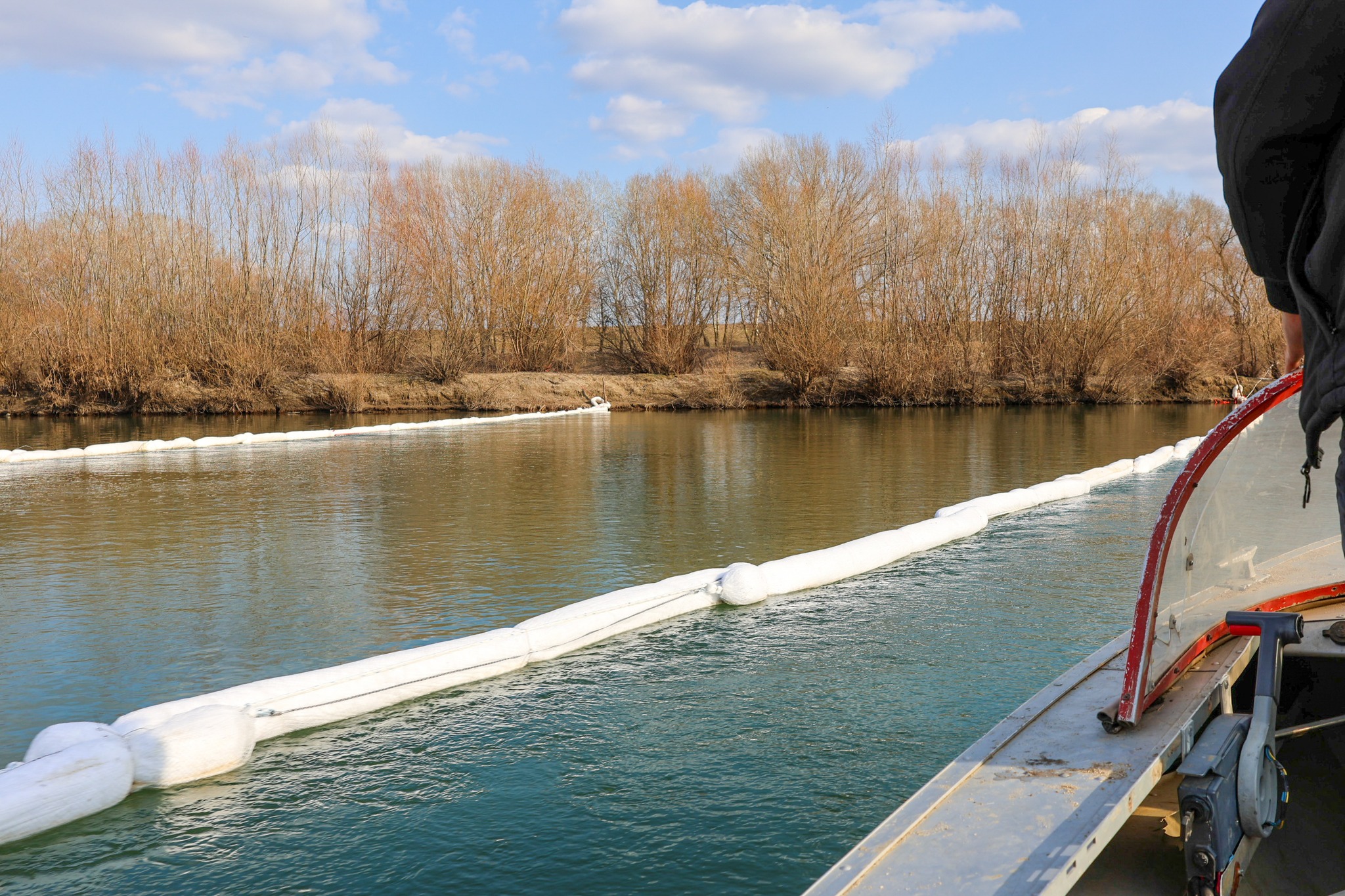
The pumping of water from the Dniester remains suspended in several areas due to the concentration of oil

Sursa foto: Ministerul Mediului

The pumping of water from the Dniester in areas where it was stopped could only be resumed after the water quality returns to safe parameters, and the concentration of petroleum products drops below the allowed limits, said the Minister of Environment, Gheorghe Hajder. He emphasized that the results of the most recent analyses indicate exceedances of petroleum concentration in several monitoring points, which poses a risk to the population’s health, reports IPN.

According to the official, the maximum permissible limit is 0.1 mg/l, but in several points the values are exceeded. In Naslavcea and Cosauti, the concentration is 0.2 mg/l, while in Rezina it reaches 0.3 mg/l. The situation remains concerning in Cosauti, an important source for the supply of the city of Balti. In Oxentea, the level has dropped to the permissible limit, after the installation of filters. In Molovata and Vadul lui Voda, the values are below the limit, indicating safe water.

“Under these circumstances, we cannot pump water into the system. If we were to do this, we would introduce into the consumer network water contaminated with substances such as toluene and benzene, which is unacceptable,” declared the minister. According to him, cleaning the network after a possible contamination could take between one and two months.

In the meantime, the authorities are providing the population with water from alternative sources. The National Crisis Management Center announced that about 15 tank trucks and 8 trailers are deployed in Balti, supplied from nearby districts, including from wells and private operators. The existing stocks are considered sufficient to cover the need.

And in the Soroca district, where water intake from the Nistru remains suspended, the authorities have activated alternative sources, including artesian wells.

An environmental alert has been issued for the Dniester basin for 15 days, following the pollution caused by the bombing of the Novodnestrovsk hydroelectric power station. The Minister of Environment recently announced that the oil spill has decreased and the situation is gradually improving, however, several northern localities remain without drinking water.


UEFA has expressed reservations about FIFA’s plan to create a commercial company that would manage the commercial rights of major competitions, including the World Cup. The organization believes that the initiative requires more clarity in terms of governance and transparency, reports IPN.

In a press release, UEFA stated that it is analyzing the proposal and that it must be examined by the national federations as well. The European body mentioned that the project raises questions about the management of the new structure and the distribution of financial benefits.

The reaction comes after FIFA announced its intention to establish FIFA Forward Enterprise (FFE), a subsidiary that would manage commercial activities and the organization of major competitions, including the World Cup and the Club World Cup.

FIFA intends to attract approximately 4.2 billion dollars by selling a minority stake of up to 20% to private investors. According to the organization, the funds will be used for the development of football, and FIFA will retain control over governance, competitions, and sporting decisions.

According to the British press, UEFA is expected to discuss the project with its 55 member federations at the end of this week, to establish a common position. Reservations about the initiative have also been expressed by the English Football Federation, CONCACAF, and the Asian Football Confederation, which have called for consultations and a transparent decision-making process.

0 FacebookTwitterPinterestEmail


The pumping of water from the Dniester remains suspended in several areas due to the concentration of oil

Sursa foto: Ministerul Mediului

The pumping of water from the Dniester in areas where it was stopped could only be resumed after the water quality returns to safe parameters, and the concentration of petroleum products drops below the allowed limits, said the Minister of Environment, Gheorghe Hajder. He emphasized that the results of the most recent analyses indicate exceedances of petroleum concentration in several monitoring points, which poses a risk to the population’s health, reports IPN.

According to the official, the maximum permissible limit is 0.1 mg/l, but in several points the values are exceeded. In Naslavcea and Cosauti, the concentration is 0.2 mg/l, while in Rezina it reaches 0.3 mg/l. The situation remains concerning in Cosauti, an important source for the supply of the city of Balti. In Oxentea, the level has dropped to the permissible limit, after the installation of filters. In Molovata and Vadul lui Voda, the values are below the limit, indicating safe water.

“Under these circumstances, we cannot pump water into the system. If we were to do this, we would introduce into the consumer network water contaminated with substances such as toluene and benzene, which is unacceptable,” declared the minister. According to him, cleaning the network after a possible contamination could take between one and two months.

In the meantime, the authorities are providing the population with water from alternative sources. The National Crisis Management Center announced that about 15 tank trucks and 8 trailers are deployed in Balti, supplied from nearby districts, including from wells and private operators. The existing stocks are considered sufficient to cover the need.

And in the Soroca district, where water intake from the Nistru remains suspended, the authorities have activated alternative sources, including artesian wells.

An environmental alert has been issued for the Dniester basin for 15 days, following the pollution caused by the bombing of the Novodnestrovsk hydroelectric power station. The Minister of Environment recently announced that the oil spill has decreased and the situation is gradually improving, however, several northern localities remain without drinking water.


A significant vegetation fire has broken out on the Greek island of Paros, one of the well-known tourist destinations in the Aegean Sea. According to euronews.ro, quoted by IPN, several localities have been evacuated, and firefighters are intervening on multiple fronts to limit the spread of the flames, as the strong wind complicates operations.

The fire broke out on Tuesday near the town of Kambi, in an area with low vegetation and waste. The Civil Protection Service of Greece has issued alerts through the 112 system for the residents of Agios Charalambos, Kambi, Bougados, Aneratzia, and Kamari, who were urged to move towards the coastal town of Aliki.

The intervention is carried out both on the ground and from the air, with the help of airplanes and helicopters. Additional firefighters and equipment have been brought from the neighboring islands of Naxos and Syros. The authorities have not reported any casualties or material damage, and the cause of the fire is under investigation.

Greece maintains a high level of alert for fires in several regions, due to high temperatures, dry vegetation, and strong winds.

In the meantime, wildfires continue in Spain and France, amidst a new heatwave. In France, 16 departments are under an orange heatwave alert, with temperatures forecasted to reach up to +41 degrees Celsius. In Gironde, authorities warn of the risk of rekindling hotspots due to the dry wind.

In Spain, the fire in Burgohondo, considered the largest in the country’s history, has destroyed over 43 thousand hectares of forest. Although thousands of evacuated people have returned to their localities, authorities warn that the situation remains unstable due to high temperatures.

0 FacebookTwitterPinterestEmail


1 IANUARIE, 2025
1 IANUARIE, 2025