

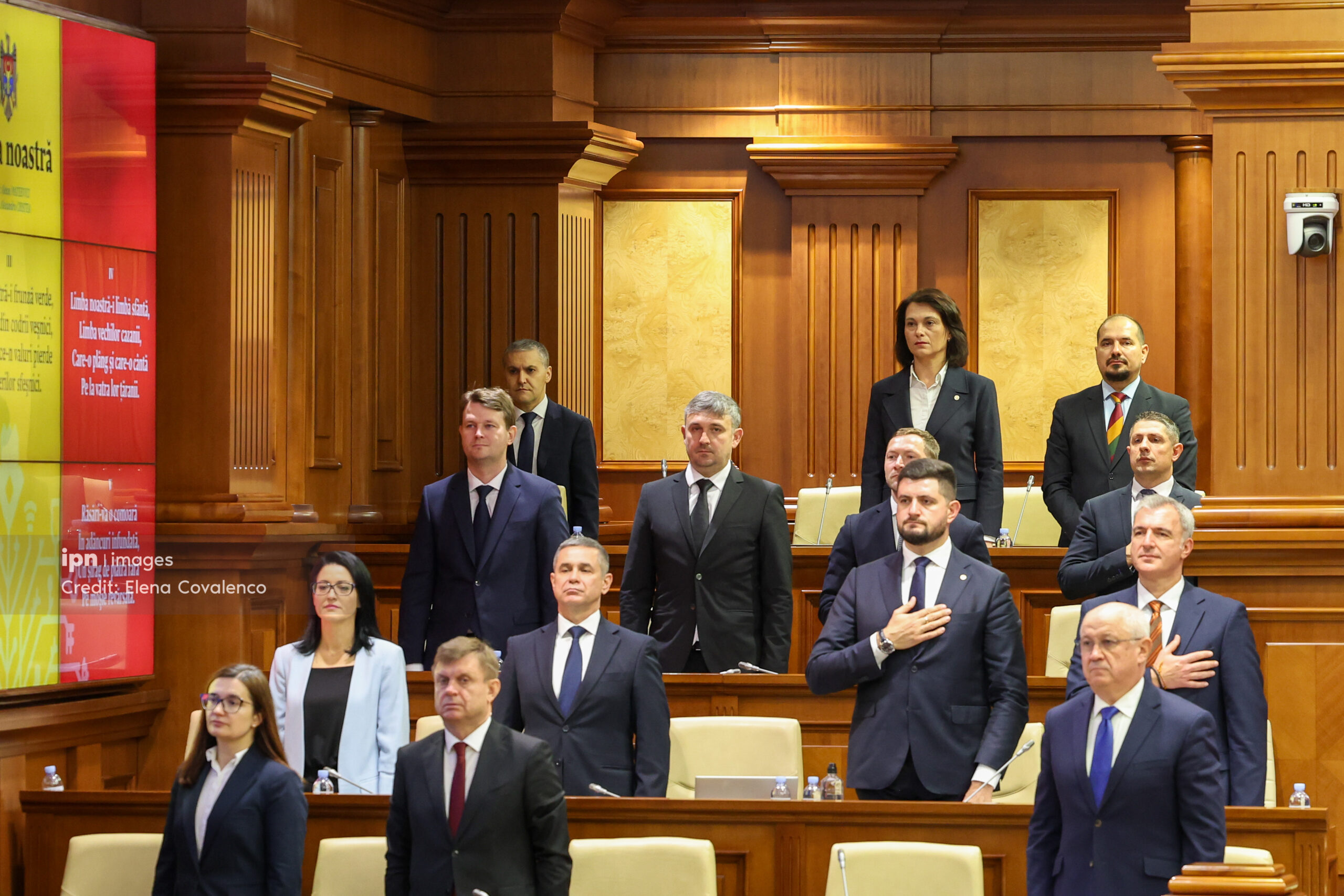
The Munteanu government was sworn in by Parliament

The cabinet of ministers, led by Alexandru Munteanu, has been sworn in. After debates lasting more than eight hours, 55 deputies from the Action and Solidarity Party voted to approve the Government’s Activity Program and grant a vote of confidence. The opposition criticized the proposed government program, calling the new executive a “sacrificial lamb,” IPN reports.

Alexandru Munteanu presented the program entitled “EU, Peace, Development,” which sets out the main directions for action of the new executive. The document provides for the completion of negotiations for accession to the European Union by 2028, thus preparing the country for full integration.

The new cabinet includes Cristina Gherasimov as Deputy Prime Minister for European Integration. Vladimir Bolea remains Deputy Prime Minister and Minister of Agriculture and Food Industry, while Mihai Popșoi continues as Deputy Prime Minister and Minister of Foreign Affairs.

Dan Perciun continues to head the Ministry of Education and Research. Dorin Junghietu remains at the Ministry of Energy, and Anatolie Nosatîi continues to head the Ministry of Defense. Ludmila Catlabuga remains at the helm of the Ministry of Agriculture and Food Industry, and Daniella Misail-Nichitin remains at the helm of the Ministry of Internal Affairs.

The new government also includes Ambassador Valeriu Chiveri as Deputy Prime Minister for Reintegration. Eugen Osmochescu takes over as Deputy Prime Minister and Minister of Economic Development and Digitalization.

Vladislav Cojuhari heads the Ministry of Justice, and Andrian Gavrilita is Minister of Finance. Natalia Plugaru becomes Minister of Labor and Social Protection, and Emil Ceban becomes Minister of Health. Gheorghe Hajder will head the Ministry of the Environment, and Cristian Jardan takes over the Ministry of Culture.

According to the Constitution, based on the vote of confidence, the president officially appoints the government, and the new executive takes office on the day it is sworn in before the head of state.


The Art Theatre of Chisinau presents the play “A Man and Several Women” by Leonid Zorin, directed by Eugeniu Matcovschi /Odeon Cultural Center /at 06:00 PM/.

The exhibition “The Unknown Work of Bessarabian Masters” continues /Constantin Brancusi Exhibition Center/ July 30-August 16/.

The personal exhibition Untitled by the artist Konstantin Benkovich continues, organized by the National Art Museum of Moldova, in partnership with the ALT Foundation /MNAM /July 30-August 30/.

The immersive exhibition continues, inspired by the mythology and mystical folklore of the Republic of Moldova, “The Forest”, created by Milen Chelea /Plai Gallery / July 23-August 6/.

The exhibition “Scent of Warm Bread. Bread in the Iron Age” continues /National Museum of History of Moldova /July 22 – September 4/.

The exhibition “Urban Archaeology and the Hidden Memory of Chisinau” continues /National Museum of History of Moldova /July 17-November 30/.

The documentary exhibition “Echo from the past, for the present and the future” continues, dedicated to the memory of the victims of Stalinist deportations and one of the most tragic episodes in the history of Bessarabia /BNRM /July 3-August 3/.

The exhibition “The Thread of Identity! The traditional Romanian costume in book illustration made by plastic artists from the Republic of Moldova” /BNRM /June 25-August 15/ continues.

The graphic exhibition by Lica Sainciuc continues, unveiled within the Creative Industries Festival /Lutnita Gallery /June 5-July 31/.

0 FacebookTwitterPinterestEmail


The Munteanu government was sworn in by Parliament

The cabinet of ministers, led by Alexandru Munteanu, has been sworn in. After debates lasting more than eight hours, 55 deputies from the Action and Solidarity Party voted to approve the Government’s Activity Program and grant a vote of confidence. The opposition criticized the proposed government program, calling the new executive a “sacrificial lamb,” IPN reports.

Alexandru Munteanu presented the program entitled “EU, Peace, Development,” which sets out the main directions for action of the new executive. The document provides for the completion of negotiations for accession to the European Union by 2028, thus preparing the country for full integration.

The new cabinet includes Cristina Gherasimov as Deputy Prime Minister for European Integration. Vladimir Bolea remains Deputy Prime Minister and Minister of Agriculture and Food Industry, while Mihai Popșoi continues as Deputy Prime Minister and Minister of Foreign Affairs.

Dan Perciun continues to head the Ministry of Education and Research. Dorin Junghietu remains at the Ministry of Energy, and Anatolie Nosatîi continues to head the Ministry of Defense. Ludmila Catlabuga remains at the helm of the Ministry of Agriculture and Food Industry, and Daniella Misail-Nichitin remains at the helm of the Ministry of Internal Affairs.

The new government also includes Ambassador Valeriu Chiveri as Deputy Prime Minister for Reintegration. Eugen Osmochescu takes over as Deputy Prime Minister and Minister of Economic Development and Digitalization.

Vladislav Cojuhari heads the Ministry of Justice, and Andrian Gavrilita is Minister of Finance. Natalia Plugaru becomes Minister of Labor and Social Protection, and Emil Ceban becomes Minister of Health. Gheorghe Hajder will head the Ministry of the Environment, and Cristian Jardan takes over the Ministry of Culture.

According to the Constitution, based on the vote of confidence, the president officially appoints the government, and the new executive takes office on the day it is sworn in before the head of state.


Romanian farmers protested in Bucharest on Thursday against the ban on sheep and goat exports, claiming losses of hundreds of millions of euros and calling for the intervention of the authorities. The demonstration degenerated into scuffles with the gendarmes, and the security forces used tear gas, reports Digi24, quoted by IPN.

The protest began in front of the headquarters of the National Veterinary and Food Safety Authority, where breeders from several counties requested to discuss with the institution’s leadership. Subsequently, the farmers moved to Victoriei Square, in front of the Government, where approximately five thousand people gathered. They demanded the resumption of exports, compensation for the losses suffered, and the resignation of the ANSVSA leadership.

The demonstration takes place against the backdrop of the crisis in the livestock sector, affected by the plague of small ruminants and by sanitary-veterinary restrictions. The European Commission has extended until December 31 the ban on sheep and goat exports from Romania to third countries, following the outbreak of a disease in Mures county.

Farmers claim that the restrictions have blocked the resumption of exports to Arab countries, and the losses for this year could exceed 300 million euros. They urgently request the lifting of trade restrictions and support measures for the affected farms.

The ANSVSA management has announced the convening of a crisis cell and stated that the institution is discussing with representatives of the European Commission to identify solutions.

0 FacebookTwitterPinterestEmail


1 IANUARIE, 2025
1 IANUARIE, 2025