

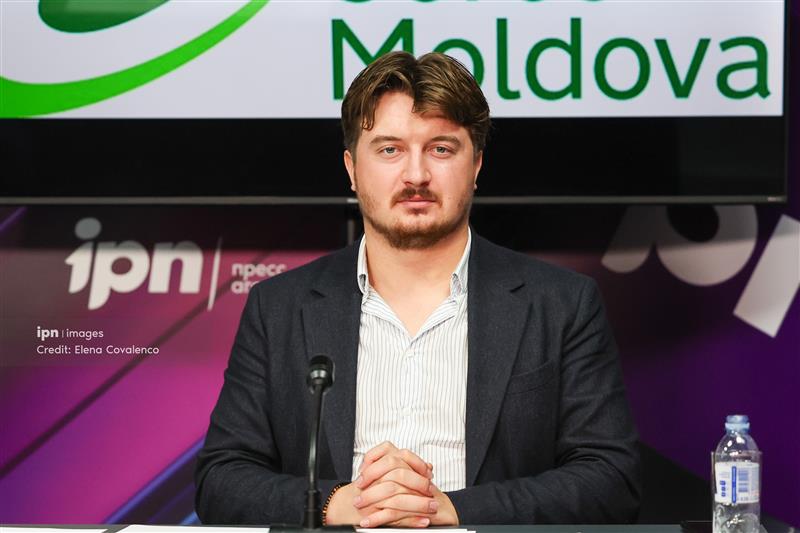
Pavel Horea: Slim chances for independent candidates in parliamentary elections

Independent candidates have very little chance of entering Parliament. The opinion belongs to Whatchdog community expert Pavel Horea and was expressed in the public debatewhat are independent candidates capable of? What do we voters need?“, organized by IPN news agency. According to the expert, the main obstacle to independent candidates is the electoral threshold.

At the parliamentary elections on September 28, four independent candidates are participating: Andrei Nastase, Olesea Stamate, Victoria Sanduta, and Tatiana Cretu.

“The chances of independent candidates making it to Parliament are slim. The 2% threshold is quite high. In terms of votes, that would be over 30 thousand votes. Which is quite a lot. Even some political formations do not achieve this score,” explained Pavel Horea.

According to the expert, another disadvantage of independent candidates is the lack of financial resources and the impossibility of massive promotion. “Another factor is the visibility and notoriety of independent candidates. Returning to financial resources, without financial means, you can’t promote yourself in the media or efficiently promote yourself online. Now, even the online field is monetized and without money, you can’t succeed in promoting yourself,” the community expert from WatchDog pointed out.

The expert also draws attention to the pragmatism of voters, who prefer to vote for political parties or blocs considered stronger. “There is also the pragmatism of the voter, who, seeing from polls that a candidate has little chance of getting into Parliament, opts to give his vote to a formation with chances. The theory of the useful vote is promoted. There is much discussion in the public space that a vote for a candidate who has no chance is a lost vote. In fact, it is not so, these votes are redistributed,” said Pavel Horea.

The public debate on the topic “Why are independent candidates capable? Why do we, the voters, need them?” is the third edition in the series of electoral information debates dedicated to the parliamentary elections of September 28. The IPN press agency is conducting this series of debates with the support of the Soros Foundation Moldova.


The Art Theatre of Chisinau presents the play “A Man and Several Women” by Leonid Zorin, directed by Eugeniu Matcovschi /Odeon Cultural Center /at 06:00 PM/.

The exhibition “The Unknown Work of Bessarabian Masters” continues /Constantin Brancusi Exhibition Center/ July 30-August 16/.

The personal exhibition Untitled by the artist Konstantin Benkovich continues, organized by the National Art Museum of Moldova, in partnership with the ALT Foundation /MNAM /July 30-August 30/.

The immersive exhibition continues, inspired by the mythology and mystical folklore of the Republic of Moldova, “The Forest”, created by Milen Chelea /Plai Gallery / July 23-August 6/.

The exhibition “Scent of Warm Bread. Bread in the Iron Age” continues /National Museum of History of Moldova /July 22 – September 4/.

The exhibition “Urban Archaeology and the Hidden Memory of Chisinau” continues /National Museum of History of Moldova /July 17-November 30/.

The documentary exhibition “Echo from the past, for the present and the future” continues, dedicated to the memory of the victims of Stalinist deportations and one of the most tragic episodes in the history of Bessarabia /BNRM /July 3-August 3/.

The exhibition “The Thread of Identity! The traditional Romanian costume in book illustration made by plastic artists from the Republic of Moldova” /BNRM /June 25-August 15/ continues.

The graphic exhibition by Lica Sainciuc continues, unveiled within the Creative Industries Festival /Lutnita Gallery /June 5-July 31/.

0 FacebookTwitterPinterestEmail


Pavel Horea: Slim chances for independent candidates in parliamentary elections

Independent candidates have very little chance of entering Parliament. The opinion belongs to Whatchdog community expert Pavel Horea and was expressed in the public debatewhat are independent candidates capable of? What do we voters need?“, organized by IPN news agency. According to the expert, the main obstacle to independent candidates is the electoral threshold.

At the parliamentary elections on September 28, four independent candidates are participating: Andrei Nastase, Olesea Stamate, Victoria Sanduta, and Tatiana Cretu.

“The chances of independent candidates making it to Parliament are slim. The 2% threshold is quite high. In terms of votes, that would be over 30 thousand votes. Which is quite a lot. Even some political formations do not achieve this score,” explained Pavel Horea.

According to the expert, another disadvantage of independent candidates is the lack of financial resources and the impossibility of massive promotion. “Another factor is the visibility and notoriety of independent candidates. Returning to financial resources, without financial means, you can’t promote yourself in the media or efficiently promote yourself online. Now, even the online field is monetized and without money, you can’t succeed in promoting yourself,” the community expert from WatchDog pointed out.

The expert also draws attention to the pragmatism of voters, who prefer to vote for political parties or blocs considered stronger. “There is also the pragmatism of the voter, who, seeing from polls that a candidate has little chance of getting into Parliament, opts to give his vote to a formation with chances. The theory of the useful vote is promoted. There is much discussion in the public space that a vote for a candidate who has no chance is a lost vote. In fact, it is not so, these votes are redistributed,” said Pavel Horea.

The public debate on the topic “Why are independent candidates capable? Why do we, the voters, need them?” is the third edition in the series of electoral information debates dedicated to the parliamentary elections of September 28. The IPN press agency is conducting this series of debates with the support of the Soros Foundation Moldova.


Romanian farmers protested in Bucharest on Thursday against the ban on sheep and goat exports, claiming losses of hundreds of millions of euros and calling for the intervention of the authorities. The demonstration degenerated into scuffles with the gendarmes, and the security forces used tear gas, reports Digi24, quoted by IPN.

The protest began in front of the headquarters of the National Veterinary and Food Safety Authority, where breeders from several counties requested to discuss with the institution’s leadership. Subsequently, the farmers moved to Victoriei Square, in front of the Government, where approximately five thousand people gathered. They demanded the resumption of exports, compensation for the losses suffered, and the resignation of the ANSVSA leadership.

The demonstration takes place against the backdrop of the crisis in the livestock sector, affected by the plague of small ruminants and by sanitary-veterinary restrictions. The European Commission has extended until December 31 the ban on sheep and goat exports from Romania to third countries, following the outbreak of a disease in Mures county.

Farmers claim that the restrictions have blocked the resumption of exports to Arab countries, and the losses for this year could exceed 300 million euros. They urgently request the lifting of trade restrictions and support measures for the affected farms.

The ANSVSA management has announced the convening of a crisis cell and stated that the institution is discussing with representatives of the European Commission to identify solutions.

0 FacebookTwitterPinterestEmail


1 IANUARIE, 2025
1 IANUARIE, 2025