

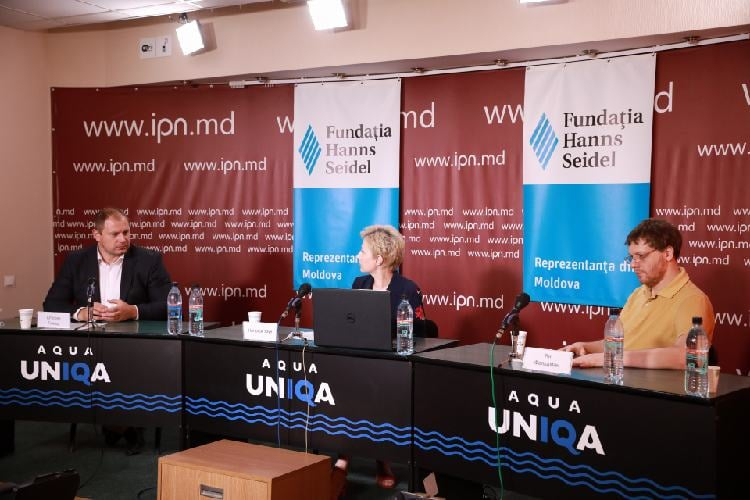
“Equality: culture, practice or illusion?” IPN debate

In Moldova, the equal rights and freedoms are guaranteed by the Constitution. On the other hand, we can meet with examples of inequality everywhere. The pay gap and career opportunities between women and men, differentiated access to medical services, high-quality infrastructure and even education possibilities in villages and towns, the absence in local communities of instruments for exerting influence on the political agenda are only some of the examples of inequality in Moldova. The problem of inequality remains an obstacle that prevents development. But this phenomenon didn’t find an appropriate place in the public and political narrative. Why? The answer to this question was looked for by the participants in IPN’s public debate “Equality: culture, practice or illusion?”.

“We can create better legislation and implement better practices for solving the problem, but when society is preoccupied with survival and is suppressed by poverty, it will be impossible to ensure equality as the people have different goals and a different system of priorities,” said jurist Ștefan Gligor, the expert of IPN’s project “Overcoming of European Integration Stereotypes by Communication”.

“After the collapse of the USSR, we not only found ourselves in a new epoch, but could not understand in what society we live and what direction we should follow. Poverty, mass migration came with the next wave and all the questions related to equality sank in the common feeling of injustice and confusion,” stated the expert.

According to him, Moldova was unable to overcome this stage swiftly because it became a rope in the geopolitical tug of war. “We didn’t have politicians, leaders who would have realized that we should first of all build the economy and then deal with concrete things based on welfare. I mean a satisfied society is more open to a civilized dialogue and it does not look for persons to blame to compensate for the dissatisfaction,” noted Stefan Gligor, expressing his conviction that we are still looking for those who are to blame for our poverty and for injustice and also for saviors.

“Our citizens didn’t understand that their salivation is in their own reflection in the mirror, that they are the unit of measurement in the new society and state building model. Work must be done on oneself so that we develop as personalities and the state will develop after us. Meanwhile, many of our social classes got stuck in the past and sink in the feeling of pity for oneself. The inequality widens as a result,” he stated.

Stefan Gligor formulated the reason for which such a situation can persist in Moldova for many years to come. “Against the uncertainty in tomorrow and the unfavorable situation of the economy, almost 100,000 children are educated not by the parents, but by relatives or by one of the parents. Their mothers and fathers are migrant workers and this situation will continue for another one-two generations that will not get enough love, compassion, knowledge and simply ice-cream or games. Consequently, they will also suffer from complexes and will try to get what they didn’t get enough at the expense of others. A new wave of inequity will appear as a result.

“We must distance ourselves from the poverty line and then many good laws will start to work, the people will enjoy greater freedom and will become more attentive to those who have less.”

Russian sociologist and philosopher Sergey Borisov, director of the Expert Center “Mera” (“Measure”) of Nizhniy Novgorod, reminded that the progress of a society consists in the growing complexity of its structure. “There is labor division and division of social functions. The more difficult the structure is, the more varied society is and the greater is its potential to develop as there are more variants,” stated the expert, noting there is also the other side.

“The more varied are the difficulties between us, the easier they can turn into discrimination. But the excessive fight for equality, as they taught is in the 20th century, can also generate unfavorable results, in particular totalitarian regimes,” said Sergey Borisov.
.
“The people are unequal from the start, by their capacities, and it is dangerous to try to equalize them. This way, we can even omit a new Mozart. But we can also, as the great thinkers of the Renaissance formulated, really ensure two things – equality of juridical rights and equality of possibilities, life chances. Society should be built so as to avoid two dangers. On the one hand, we should not allow inequality as injustice. On the other hand, we should not limit the equality of possibilities because we can fight so for the rights of the minorities that no minorities will remain.”
 
As the head of the Council for Preventing and Eliminating Discrimination and Ensuring Equality Ian Feldman said, the number of complains to the Council, which was founded as part of the implementation of the Association Agreement with the EU, rises aurally. “We started from 140 complaints a year, but now the figure stands at 300.”

Ian Feldman considers the creation of the Council in a move to ensure equality, as the Moldovan side decided when looking for a solution, is an accomplishment. “In our case, there was constituted a body that not only fixes the problem, but also formulates recommendations and solutions that must be mandatorily implemented. We set the deadlines and can impose fines for discrimination and also for the non-implementing of the Council’s decisions,” he stated.

He noted that among the results of this parajudicary body is the change of the perception of the phenomenon of inequality. “We, regularly, once in two-three years, carry out large studies to measure the social distance in relation to particular groups of people. I want to note that this distance in 2018 became significantly shorter compared with 2015,” noted Ian Feldman.

The public debate “Equality: culture, practice or illusion?” forms part of the series of debates “Overcoming of European Integration Stereotypes by Communication”. IPN News Agency stages the debates with support from the Hanns Seidel Foundation.


The Cabinet of Ministers convenes for a meeting /Government House, entrance from Pushkin Street /at 10:00 AM/.

Public consultations are taking place regarding the draft law for amending the Electoral Code /Parliament, Europa Hall /at 10:00 AM/.

The public movement Sovereigns of Moldova and the public organization ADOR My City are organizing a press conference on the topic: “Results of the online Orthodox Conference “Protection of Orthodox Unity in Moldova”. Announcement of the resolution adopted at the conference” /Infotag /at 11:00 AM/.

The City Hall of Chisinau is conducting public consultations on the “Territorial Cooperation” and “Traffic and Transport” foundation studies, developed within the process of updating the General Urban Plan Chisinau 2040 /Pretura of the Central sector /at 01:00 PM/.

The Investment Agency organizes workshops dedicated to Moldovans settled abroad as part of the Open Doors Day, organized on the occasion of the Diaspora Days 2026 /Investment Agency /at 02:00 PM/.

Public consultations are taking place regarding the draft law for amending the Electoral Code /State University Hall in Comrat, Galatana street no. 17 /at 03:00 PM/.

0 FacebookTwitterPinterestEmail


“Equality: culture, practice or illusion?” IPN debate

In Moldova, the equal rights and freedoms are guaranteed by the Constitution. On the other hand, we can meet with examples of inequality everywhere. The pay gap and career opportunities between women and men, differentiated access to medical services, high-quality infrastructure and even education possibilities in villages and towns, the absence in local communities of instruments for exerting influence on the political agenda are only some of the examples of inequality in Moldova. The problem of inequality remains an obstacle that prevents development. But this phenomenon didn’t find an appropriate place in the public and political narrative. Why? The answer to this question was looked for by the participants in IPN’s public debate “Equality: culture, practice or illusion?”.

“We can create better legislation and implement better practices for solving the problem, but when society is preoccupied with survival and is suppressed by poverty, it will be impossible to ensure equality as the people have different goals and a different system of priorities,” said jurist Ștefan Gligor, the expert of IPN’s project “Overcoming of European Integration Stereotypes by Communication”.

“After the collapse of the USSR, we not only found ourselves in a new epoch, but could not understand in what society we live and what direction we should follow. Poverty, mass migration came with the next wave and all the questions related to equality sank in the common feeling of injustice and confusion,” stated the expert.

According to him, Moldova was unable to overcome this stage swiftly because it became a rope in the geopolitical tug of war. “We didn’t have politicians, leaders who would have realized that we should first of all build the economy and then deal with concrete things based on welfare. I mean a satisfied society is more open to a civilized dialogue and it does not look for persons to blame to compensate for the dissatisfaction,” noted Stefan Gligor, expressing his conviction that we are still looking for those who are to blame for our poverty and for injustice and also for saviors.

“Our citizens didn’t understand that their salivation is in their own reflection in the mirror, that they are the unit of measurement in the new society and state building model. Work must be done on oneself so that we develop as personalities and the state will develop after us. Meanwhile, many of our social classes got stuck in the past and sink in the feeling of pity for oneself. The inequality widens as a result,” he stated.

Stefan Gligor formulated the reason for which such a situation can persist in Moldova for many years to come. “Against the uncertainty in tomorrow and the unfavorable situation of the economy, almost 100,000 children are educated not by the parents, but by relatives or by one of the parents. Their mothers and fathers are migrant workers and this situation will continue for another one-two generations that will not get enough love, compassion, knowledge and simply ice-cream or games. Consequently, they will also suffer from complexes and will try to get what they didn’t get enough at the expense of others. A new wave of inequity will appear as a result.

“We must distance ourselves from the poverty line and then many good laws will start to work, the people will enjoy greater freedom and will become more attentive to those who have less.”

Russian sociologist and philosopher Sergey Borisov, director of the Expert Center “Mera” (“Measure”) of Nizhniy Novgorod, reminded that the progress of a society consists in the growing complexity of its structure. “There is labor division and division of social functions. The more difficult the structure is, the more varied society is and the greater is its potential to develop as there are more variants,” stated the expert, noting there is also the other side.

“The more varied are the difficulties between us, the easier they can turn into discrimination. But the excessive fight for equality, as they taught is in the 20th century, can also generate unfavorable results, in particular totalitarian regimes,” said Sergey Borisov.
.
“The people are unequal from the start, by their capacities, and it is dangerous to try to equalize them. This way, we can even omit a new Mozart. But we can also, as the great thinkers of the Renaissance formulated, really ensure two things – equality of juridical rights and equality of possibilities, life chances. Society should be built so as to avoid two dangers. On the one hand, we should not allow inequality as injustice. On the other hand, we should not limit the equality of possibilities because we can fight so for the rights of the minorities that no minorities will remain.”
 
As the head of the Council for Preventing and Eliminating Discrimination and Ensuring Equality Ian Feldman said, the number of complains to the Council, which was founded as part of the implementation of the Association Agreement with the EU, rises aurally. “We started from 140 complaints a year, but now the figure stands at 300.”

Ian Feldman considers the creation of the Council in a move to ensure equality, as the Moldovan side decided when looking for a solution, is an accomplishment. “In our case, there was constituted a body that not only fixes the problem, but also formulates recommendations and solutions that must be mandatorily implemented. We set the deadlines and can impose fines for discrimination and also for the non-implementing of the Council’s decisions,” he stated.

He noted that among the results of this parajudicary body is the change of the perception of the phenomenon of inequality. “We, regularly, once in two-three years, carry out large studies to measure the social distance in relation to particular groups of people. I want to note that this distance in 2018 became significantly shorter compared with 2015,” noted Ian Feldman.

The public debate “Equality: culture, practice or illusion?” forms part of the series of debates “Overcoming of European Integration Stereotypes by Communication”. IPN News Agency stages the debates with support from the Hanns Seidel Foundation.


Two commercial ships owned by Turkish companies were attacked by drones in the Black Sea, and several crew members were injured. The authorities in Ankara condemn the incidents and warn that the intensification of attacks on civil maritime transport could affect navigation safety and food supply, reports IPN.

The Turkish Ministry of Foreign Affairs announced that the attacks took place after the ships left the Russian port of Novorossiisk on Monday evening. Several crew members were injured, and their condition is being monitored.

Ankara has expressed concern about the escalation of the conflict between Russia and Ukraine in the Black Sea, emphasizing that the incidents affect civil maritime transport. The Turkish Ministry of Foreign Affairs has appealed to all parties involved to take urgent measures to ensure navigation safety, warning that risks to commercial routes could have consequences on food supply.

According to the MarineTraffic maritime traffic monitoring platform, the targeted ships – Yasar and Nadezhda – sail under the flags of Panama and Cameroon, but are owned by Turkish companies.

0 FacebookTwitterPinterestEmail


1 IANUARIE, 2025
1 IANUARIE, 2025