

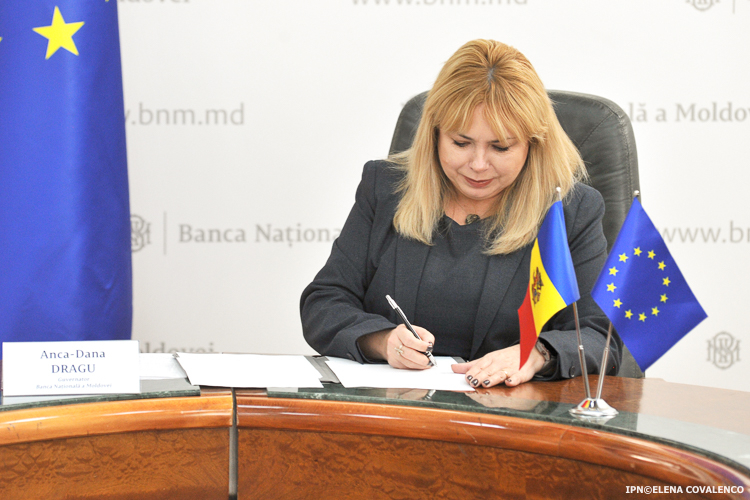
NBM signs application for accession to Single Euro Payments Area

The National Bank of Moldova (NBM) has signed an application for Moldova’s accession to the Single Euro Payments Area (SEPA). Joining SEPA would mean lack of differences between cashless payments in euros, national or cross-border, and also cheaper transactions, reduced time and security of transfers, IPN reports.

According to NBM governor Anca Dragu, today the National Bank clearly and unequivocally states its desire to be part of the European single payments system. It also shows its commitment and contribution to the European path and this is an important moment for the economy of the Republic of Moldova and for all participants in economic circuits.

The governor noted that the costs are among the benefits of belonging to SEPA. It is to the advantage of all participants to have transparent, safe payments and sustainably pricing. With this system, a payment could be made within 24 hours and a person will not pay 50 per transaction, but, for example, €3 euros, for payments in the own name or in the name of companies.

“It is a categorical step towards strengthening the European single market, and for Moldova there is the commitment that we can be part of the European market,” noted Anca Dragu.

The evaluation and connection to the system follow next. It is estimated that the evaluation will take one year. This will include the dialogue with the European Payments Council. The connection period will last for about half a year.

Dorel Noroc, president of the Moldovan Banks Association, believes that cross-border, international payments will reach another level with SEPA, while Moldovan citizens and companies will feel the benefits of integration into the EU’s payments market. Together with the accession to SEPA, the advantages enjoyed by citizens when making national payments will also be accessible for international payments. SEPA means convenience, speed and safety. The connection to SEPA provides a very important basis for the country’s economic integration into the EU’s area and will exclude any type of barrier from the transfer of money from Moldova to the EU and vice versa.

Andrei Stamatian, chairman of the Management Board of a commercial bank, noted that he worked in the Romanian banking system and saw SEPA in action. As citizens receive money from abroad at high costs, without having a bank account, if they understand the advantages of SEPA, they will be determined to open a bank account. Thus, banks can expand financial intermediation, which is a desideratum in the Republic of Moldova.

There are 36 countries in the SEPA zone, including all EU member states.


The fair of natural and local products from local producers and craftsmen takes place (24-26 July) /Mircea cel Batran Alley/ at 08:00 AM/.

Parliamentary committees are holding meetings /Parliament /at 08:30 AM–09:30 AM/.

The Court of Accounts is examining the audit report on the financial statements of Palanca Village, Stefan Voda district /ccrm.md /at 09:00 AM/.

FIODOR GAGAUZ holds a press briefing entitled: “Important Statement on the Situation in Gagauzia and Next Steps” /Conference Room of the IPN Agency, Theater Street, 2/2, 3rd floor, online at www.ipn.md, FB.com/ipn.md, YouTube, Privesc.EU /at 10:00 AM/.

The National Agency for Energy Regulation convenes a meeting /ANRE /at 10:00 AM/.

The Superior Council of Magistracy is holding the national conference: “Strengthening the attractiveness of the judge profession: immediate measures and sustainable solutions” /Str. Vlaicu Parcalab, 48 /at 10:00 AM/.

(NEW) The Party for the Development and Consolidation of Moldova is organising a protest against the increase in natural gas tariffs /ANRE /10.00/.

The Party for the Development and Consolidation of Moldova is organising a protest against the increase in natural gas tariffs /ANRE /at 10.00 AM/.

The city of Chisinau hosts the XI edition of the international sports festival “Golden Bull” (July 23-26) /Athletics Manege /at 10:30 AM/.

IPN PRESS AGENCY invites media representatives to the public debate on the topic: “Reform of local public administration and the amalgamation process – from voluntary to normative”. Participants: Dan Nicorici, Program Director, Center for Policies and Reforms, Oleg Ivancioglo, Administrator of AO “Initiative Shoulder to Shoulder” /Conference room of the IPN Agency, Teatrului street, 2/2, 3rd floor, online at www.ipn.md, FB.com/ipn.md, YouTube /at 11:00 AM/.

Parliament is convened for a plenary session /at 11:00 AM/.

The Jewish Community of Moldova is organizing a ceremony to commemorate the 85th anniversary of the establishment of the Chisinau Ghetto /Monument of the Ghetto Victims, Jerusalem Street /at 11:00 AM/.

The Chisinau City Council meeting continues /Chisinau City Hall /at 01:00 PM/.

The Central Election Commission is holding a meeting /CEC /at 02:00 PM/.

The governing council of the National Agency for Quality Assurance in Education and Research convenes a meeting /ANACEC, 38A Hancesti Highway /at 03:00 PM/.

0 FacebookTwitterPinterestEmail


NBM signs application for accession to Single Euro Payments Area

The National Bank of Moldova (NBM) has signed an application for Moldova’s accession to the Single Euro Payments Area (SEPA). Joining SEPA would mean lack of differences between cashless payments in euros, national or cross-border, and also cheaper transactions, reduced time and security of transfers, IPN reports.

According to NBM governor Anca Dragu, today the National Bank clearly and unequivocally states its desire to be part of the European single payments system. It also shows its commitment and contribution to the European path and this is an important moment for the economy of the Republic of Moldova and for all participants in economic circuits.

The governor noted that the costs are among the benefits of belonging to SEPA. It is to the advantage of all participants to have transparent, safe payments and sustainably pricing. With this system, a payment could be made within 24 hours and a person will not pay 50 per transaction, but, for example, €3 euros, for payments in the own name or in the name of companies.

“It is a categorical step towards strengthening the European single market, and for Moldova there is the commitment that we can be part of the European market,” noted Anca Dragu.

The evaluation and connection to the system follow next. It is estimated that the evaluation will take one year. This will include the dialogue with the European Payments Council. The connection period will last for about half a year.

Dorel Noroc, president of the Moldovan Banks Association, believes that cross-border, international payments will reach another level with SEPA, while Moldovan citizens and companies will feel the benefits of integration into the EU’s payments market. Together with the accession to SEPA, the advantages enjoyed by citizens when making national payments will also be accessible for international payments. SEPA means convenience, speed and safety. The connection to SEPA provides a very important basis for the country’s economic integration into the EU’s area and will exclude any type of barrier from the transfer of money from Moldova to the EU and vice versa.

Andrei Stamatian, chairman of the Management Board of a commercial bank, noted that he worked in the Romanian banking system and saw SEPA in action. As citizens receive money from abroad at high costs, without having a bank account, if they understand the advantages of SEPA, they will be determined to open a bank account. Thus, banks can expand financial intermediation, which is a desideratum in the Republic of Moldova.

There are 36 countries in the SEPA zone, including all EU member states.


The installation of photovoltaic systems, heat pumps, and batteries for storing electrical energy will require fewer documents and administrative procedures. The Parliament approved in the second reading a bill that simplifies the authorization of these works and establishes rules for the placement of energy storage installations, reports IPN.

One of the changes provides for the inclusion of electric energy storage installations in the category of works carried out in a simplified regime. Thus, for the installation of photovoltaic panels and heat pumps in individual houses, duplexes, terraced houses, blocks, on roofs or facades, project documentation will only be required for the electricity compartment.

The project also sets rules for the installation of storage batteries near photovoltaic parks or other energy, commercial, agricultural or industrial objectives. The technical documentation will be limited to the strictly necessary, and the authorities will not be able to request additional documents without a clear basis.

The technical requirements may include, as appropriate, aspects related to electricity, automation, building resistance, and fire protection. For systems installed in protected areas or near historical monuments, the approval of the authority for the protection of cultural heritage will be necessary.

The authors of the project, deputies of the Action and Solidarity Party, argue that simplifying procedures will accelerate investments in renewable energy and will facilitate the installation of solutions for producing and storing electrical energy.

0 FacebookTwitterPinterestEmail


1 IANUARIE, 2025
1 IANUARIE, 2025