
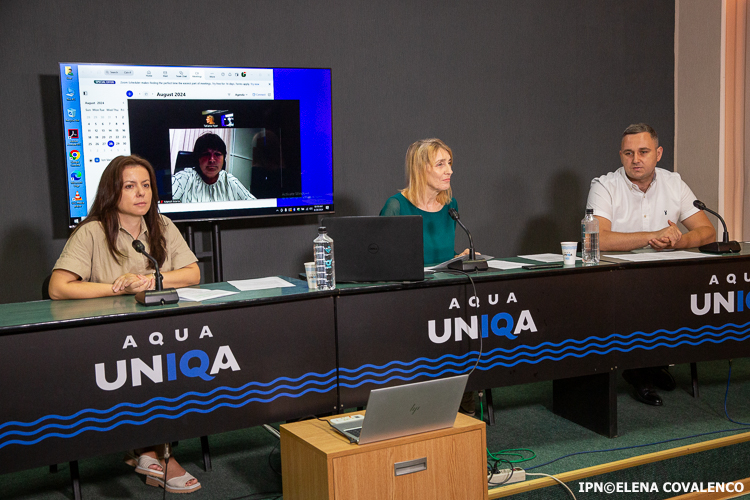
Officially launched in October 2022, the EU4Moldova: Local Communities Program aims to improve living standards in rural areas. To achieve this ambitious goal, the Program intends to increase the quality of public services in the selected communities, among other objectives, which were discussed during an IPN livescast on Monday.
The program also aims to create business opportunities and jobs, and strengthen local development through the active participation of communities. With a total budget of €27.4 million, the program is expected to be completed by December 2025.
Aurelia Bahnaru, president of the resource center e-Circular, said that the program represents a special opportunity for rural localities, especially considering the persisting problem of fund scarcity at the national level. “I’m glad to see that in some settlements the population is again growing, living conditions are getting better, infrastructure is constantly developing, and people are returning home. And such programs allow people to stay in Moldova, live and develop here”.
Viorel Jardan, mayor of Lozova commune in Străseni district, says that this program smartly targets the three key regions of the country, the center, north and south, with one district being selected from each. According to him, these are quite active districts, which now have the opportunity to move faster, reaching the needs of every citizen.
Viorel Jardan believes that thanks to the multitude of areas of intervention this program will actually produce tangible results. Intervention areas include rehabilitating schools, supporting disadvantaged families, and building water supply and sewer systems, among many others. “The most important thing is the support for the local public administration in drafting strategic planning documents and subsequently going with us through all the stages to make sure the results are fully delivered”, the mayor added.
Maria Manole, mayor of Zubrești village in the same district, said that people at the countryside do not want to be different from those living in cities and indeed have expectations regarding the services provided by the local authorities. The program is now helping the village build a sewer system with a treatment facility. Maria Manole added that water supply is another key service that the locals need.
The livecast was the seventh installment of the Benefits of EU Accession Series, run by IPN with the support of the Soros Moldova Foundation.
- Cristina Gerasimov says how €1.8bn package announced by Ursula von der Leyen will be used
- Vladimir Bolea and Ursula von der Leyen discuss EU support for Moldovan farmers
- Gagauz governor sanctioned by EU among other officials of the autonomy
- EP resolution on strengthening Moldova’s resilience against Russian interference ahead of elections
- Vacation in Vienna and European money helped Olesea Plugaru start meat business
- What changed in Sweden after joining the EU? Ambassador Katarina Fried
- EU integration is a fundamental option, Romanian official
- Foreign Minister greets new ambassador of France in Chisinau
- Transition to green economy and energy efficiency are becoming priorities for Moldova
- Best way to deal with misinformation is to tell the truth, ambassador
- Opening of Denmark’s embassy in Chisinau was based on Moldova’s desire to get closer to EU
- Moldova is facing an election. IPN interview with Denmark’s first ambassador to Moldova
- 76% of respondents of Entrepreneurs’ Barometer support European integration
- EU and ILO donate new body cameras for labor inspectors
- Chișinău-Tiraspol tourist train restored after a break of 20 years
- EU is considering providing emergency aid to Moldovan farmers
- Government banks on diaspora’s active involvement in EU accession process
- Russian troops must be withdrawn from Moldova immediately. PM Recean’s message at UN Assembly
- European financing for transport projects
- Priest Andrei Rusu: Religion remains a pillar of European values
- Young people of Moldova more actively involved civically thanks to German partners
- All parliamentary majorities in Moldova were pro-European, Igor Boțan
- Global processes can only be influenced together, Prof. Dr. Norbert Lammert
- Moldova’s integration into EU is a strategic objective, former President of German Bundestag
- Being part of EU means acting unitedly in confronting common challenges. IPN interview with Prof. Dr. Norbert Lammert
- Interior Ministry veterans explain why it is important to vote in Oct. 20 referendum
- What Europe’s future enlargement chief Marta Kos means for Moldova
- It’s time to mobilize and complete European path, ex-deputy prime minister
- Triangle commitments. What advantages do we enjoy
- Firm support for Moldova’s European future
- We are stronger, statements at Moldova Partnership Platform
- Victoria Cociug: European Commission’s money goes to salaries of researchers through Horizon Europe
- Vitalie Moraru: €5.38 million was attracted by Moldova through Horizon Europe
- Aurelia Hanganu: Horizon Europe involves identification of solutions for all aspects of life
- European integration of Moldova’s research sector. IPN debate
- Stable and democratic Moldova will ensure stability in entire region, Romanian official
- “We will help Moldova to become a European state,” French foreign minister
- German Foreign Minister in Chisinau: We support Moldova’s and Ukraine’s freedom
- €9 million in financial support from Denmark
- Financial commitments at Moldova Partnership Platform: €80m in grants and €300m in loans
- Mihai Popșoi: Support mobilized through Moldova Partnership Platform is crucial
- Luminița Odobescu: Moldova is not alone and today’s meeting confirms this
- Fifth edition of Moldova Partnership Platform underway
- Gabrielius Landsbergis: Lithuania will continue to stand by Moldova on its European path
- Fuss at Palace of the Republic. Foreign delegations expected to arrive early Tuesday
- Daniel Vodă: Our friends who want a European Moldova come to Partnership Platform
- Moldova has no other more beneficial path than joining EU, Nicolae Timofti
- PM of Luxemburg: We want to stand by Moldova on path to great European family
- Citizens for Europe about EU accession, sovereignty and neutrality of country
- Mihai Popșoi: After trying to spoil our relationship with Ukraine, some act similarly with regard to Hungary
- 65 delegations expected to attend Conference of Moldova Partnership Platform in Chisinau
- PM Recean in Bratislava: Slovakia’s support is very important for us
- (Pre-) EU Accession in 2030: The Western Balkans and the Eastern Wing – Ukraine, Moldova, and Georgia, Analysis by Dionis Cenușa
- Three more parties request to be registered as participants in referendum
- Model and text of ballot paper for referendum approved
- PAS will apply to be registered as a participant in referendum with option “For”
- Justice sector reforms and fight against corruption are founding elements for any democracy, forum
- Latvia reaffirms its support for Moldova’s European path
- Opportunity to create Economic and Social Committee in Moldova discussed at roundtable
- Ex-President of Estonia: It is our duty for Moldova to become part of EU; we experienced similar challenges
- Sections of Chisinau streets to be closed to traffic due to Euro Marathon
- Tatiana Romaniuc: Eu4Culture contributed to developing culture in Cahul
- Parascovia Marandici: Costești Socio-Cultural Center provides activities to suit everyone’s taste
- Diana Josu-Braniște: With EU support, cultural institutions in Ialoveni are being modernized
- Péter Szijjártó: Hungary offers support for Moldova to join EU as soon as possible
- EU investments in Moldova’s cultural sector. IPN debate
- European integration and geopolitical games of Russian Church in Moldova
- Hungarian minister of foreign affairs to visit Chisinau
- Mayors urge people to vote “Yes” at October 20 referendum
- Simplified procedure for introducing cosmetic products from EU into Moldova
- Donald Tusk in Parliament: Poland will continue to support Moldova’s European path
- Donald Tusk: Enlargement and cooperation among EU countries is in the interest of all of Europe
- Polish PM Donald Tusk welcomed in Chisinau
- Maria Băcioi: In any business, maintaining quality is the hardest thing to do
- Dorina Baciu: Our cheeses are exclusive and of a high quality
- CCI deputy chairman: We support entrepreneurs through various financing programs
- Mihai Ghimpu calls on former Presidents to support and promote October 20 referendum
- New landfill and sorting and composting station to be built in Cahul
- EU4Business Initiative, contributions to development of SMEs in Moldova. IPN debate
- Deputy Premier at Bled Strategic Forum: EU enlargement is a historic opportunity
- Ion Ceban: National Alternative Movement will support referendum on amending Constitution
- EU provides Moldova with €9.5 million to address security challenges
- Almost 50% of Moldovans are for amending Constitution to enshrine path to EU, poll
- Three European Premiers to visit Moldova in September
- Chief of European Public Prosecutor’s Office assures that Moldova will be further assisted to reform justice system
- European Chief Prosecutor: Whole society must be involved in fight against corruption, not just justice system
- Deputy Premier Popșoi to attend 19th Bled Strategic Forum
- Libraries will promote European values through reading within national campaign
- Mihai Popșoi at GLOBSEC: European course ensures prosperity and growth for Moldova
- European Chief Prosecutor Kovesi to visit Chisinau Sep.2
- Not having running water is a major disadvantage, says rural mayor
- Lozova mayor praises Clean Water for All, part of EU4Moldova Program
- Clean Water for All project to benefit over 19,000 people in Straseni
- Moldova to negotiate €200M loan for reforestation
- Baltic leaders sign declaration supporting Moldova’s EU membership bid
- EU Ambassador: This year Moldova’s independence takes on a new meaning
- Independence Day wreath-laying: ‘Let us all come together as a nation’
- Maia Sandu: We choose a future in peace and well-being
- Born Independent: Moldova is a young country that needs to put in a lot of work to prosper
- Moldova to host Electro Marathon on September 7 and 8
- Moldova Partnership Platform to assemble Sep.17
- Olaf Scholz in Chisinau: Germany stands firmly with Moldova
- EU4Moldova, Cahul and Ungheni. IPN debate
- Ion Dolganiuc: Colibași market modernized thanks to EU4Moldova: Key Regions Program
- Nicolae Dandiș: EU4Moldova: Key Regions is one of the most effective programs we have benefited from
- Moldova, Italy to cooperate in fighting crime
- What it really means to be European: lessons learned from the EU experience. Op-Ed by Laurențiu Plesca
- German Chancellor arriving in Chisinau today
- Moldova, Sweden sign defense cooperation agreement
- Mihai Tîrșu: Moldova is quite advanced in implementing EU Directive on energy performance of buildings
- Ion Muntean: EU has a very active role in improving energy efficiency in Moldova’s residential sector
- Chisinau resident: After energy efficiency improvements, we pay only for what we actually consume
- Young Frenchman cycles across Europe from Chisinau to Brussels
- Improving energy efficiency in the residential sector with European support. IPN Debate
- ‘I know you care about the country’, president Sandu tells Moldovans in GOTV effort
- Moldova and the EU: an advantageous Partnership in Progress. Op-Ed written by Dr. Dorina Baltag
- Unions, employers propose 6,000 lei minimum salary from 2025
- Moldova and Spain complete procedures for mutual recognition of driving licenses
- An opportunity to profoundly transform the everyday life of Moldovans. Op-Ed by Laurențiu Plesca
- Over 2,500 children participated in European Excursion educational program
- Informal employment in Moldova is second-highest in Europe
- European support for Moldovan industry: benefits for employers and employees. IPN debate
- Dual education has gained momentum, says state secretary
- Ionel Factory HR manager praises dual education as vacancy-filling solution
- State partially compensates expenses of companies implementing dual education
- 2024 Euro Marathon to take place Sep. 8
- EU and Moldova’s military resilience. Op-Ed by Anatol Țăranu
- Estonia to buy armored vehicles for Moldova valued at €46M
- ALDE stays out of presidential race, but will promote EU referendum
- German Chancellor Scholz to visit Moldova Aug. 21
- Ludotheque inaugurated at Popeasca secondary school with Italy’s support
- Grants for investigative journalists
- “Through Art in Europe”, short film contest for students
- Three cars bought with EU support reach social workers in northern Moldova
- Border between Ukraine and Moldova safer thanks to EU project
- EU urges Moldovan citizens to beware of Russian fakes
- 219 households became energy efficient thanks to EU support
- The Geopolitical Narratives in Georgia, Moldova and Armenia. Analysis by Dionis Cenusa
- Over 39,000 vouchers redeemed as part of “Rabla for household appliances” program
- EU-funded program increases Moldova’s energy resilience
- European integration means not only geopolitics, but also internal reform, Expert-Grup
- Lithuania provides National Army with thermal night vision devices and drones
- Young people from southern Moldova bring Europe at home
- European Romania versus “Moldovenist” Republic of Moldova and integration into EU. Op-Ed by Anatol Țăranu
- Siegfried Mureșan: Staying at home on referendum day means playing into Russia’s hands
- 54% of respondents consider EU is Moldova’s main development partner
- Over 66% of Moldovans intend to participate in referendum
- 20 firefighters left for Greece for staff rotation in pre-positioning mission
- EU accession referendums in member states and Republic of Moldova. Op-Ed by Victor Pelin
- Green House Program to extend nationwide
- Ludmila Pavlov: Thanks to EU support, education in Moldova moves to a new level
- Iargara supplied with new waste management equipment with EU support
- Gennady Rybakov: Francophone bilingual classes are part of educational system adjusted to European standards
- Olga Balmus: If we want qualified specialists, we need to understand value of European investments
- Quality education in Moldova, role of European projects. Context and impact. IPN Debate
- Radiology and medical imaging laboratory at Criuleni Health Center, thanks to support of EU and UNDP
- Moldova to benefit from EU investments in road infrastructure at mouths of the Danube
- Cristina Gerasimov: Moldova will double its efforts towards joining EU
- 150,000 families will benefit from vouchers to replace old appliances
- Romanian MEP Rareș Bogdan elected vice-chair of EP Committee on Foreign Affairs
- Leonid Boaghe: Creating energy communities will increase efficiency of the sector
- Dinu Bubulici: Advantages of diversifying renewable energy sources can also be obtained through European projects
- Dorina Onici: People must take advantage of EU opportunities regarding transition to alternative energy
- Transforming energy sector through European funding: Concrete examples and lessons learned. IPN debate
- Cristina Gerasimov: We have a rare window of opportunity that history offers us
- Breastfeeding Caravan starts in Hâncești
- European integration reflected in constitutions of member states. Op-Ed by Victor Pelin
- Victor Parlicov: Bills can be reduced only by rationalizing energy consumption
- World leaders pledge to continue cooperation to maintain peace in Moldova
- For 19 of 51 LAGs, no sources of funding have been yet identified
- Specialists in European integration gathered in Chisinau to share experience
- Moldova’s accession to EU: expected advantages. Op-Ed by Anatol Țăranu
- Moldova at European Political Community Summit
- Next year’s elections are real stake of those who intend to take part in electoral competition, opinions
- Ursula von der Leyen, at the helm of European Commission by Moldovans’ will as well
- European Commission grant for road infrastructure rehabilitation
- European Parliament seeks adequate support for Moldova and Ukraine, Siegfried Mureșan
- 219 households improve energy efficiency with financial support of EU
- MP Radu Marian about how foreign funding was used
- Viorel Furdui: Over 80% of local administrations are pro-European
- Andrei Curăraru: Affiliation to European community must be constantly communicated through concrete examples
- Natalia Stercul: Citizens’ involvement in European integration process must be major goal of society
- Advantages and responsibilities of citizen in strengthening country’s European future. IPN debate
- Ministry of Energy launches first tender contests for large renewable energy capacities
- 20 Moldovan servicemen to take part in EU operation in Bosnia and Herzegovina
- EU donates patrol vehicles and body cameras to police in Moldova
- Poland and UNDP to renovate and equip one of 35 model schools in Moldova
- EU contributes to supporting energy efficiency projects in Moldova’s residential sector
- Ambassador Felix Baumann: Moldova continues to promote democracy and freedom
- Switzerland assisted Moldova through projects to the value of 6bn lei
- Georgia’s EU accession suspended
- Iurie Ciocan: All political camps are already campaigning on referendum
- Citizens for Europe: Everyone must get involved for country’s European future
- UK general election: lessons for Eurosceptics. Op-Ed by Victor Pelin
- Anatolie Nosatyi: Second radar is being assembled and will be delivered to Moldova in 2025