

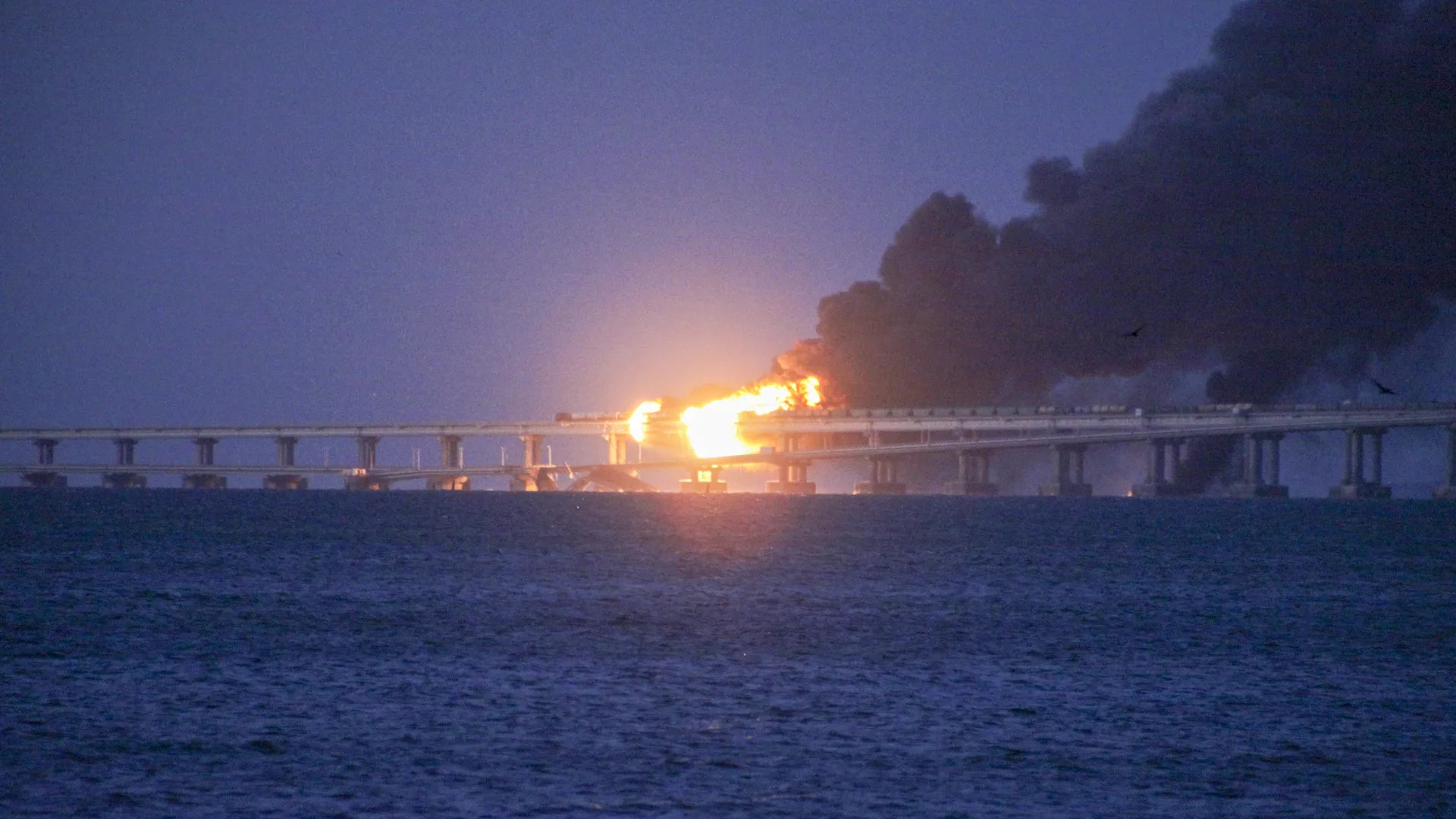
Ukraine’s attacks on Crimea affect the supply of the Russian army, expert Watchdog

Photo source: axios.com

Crimea risks facing increasingly significant logistical difficulties following the recent Ukrainian attacks on transport infrastructure, which targeted the peninsula’s main access and supply routes, asserts security expert Artur Lescu from the WatchDog Community, reports IPN.

According to the expert, in recent months, Ukraine has expanded its production capabilities of medium-range drones and cruise missiles, which has allowed it to strike more frequently at points considered strategic for supplying Crimea. Artur Leșcu states that one of the main bridges ensuring the terrestrial connection between Crimea and the northern part of the peninsula, the one at Ciongar, has been damaged, and traffic on it is blocked. Consequently, traffic would have been redirected through the Armeansk area, but the capacity of alternative routes is limited, which could cause delays in the transport of goods.

At the same time, on the night of June 11, Ukrainian drones attacked the bridges over the North Crimean Canal in the Armyansk-Perekop area. According to assessments cited by the expert, traffic is affected on the main road bridges that connect Crimea with the Herson region, controlled by Russia.

In his opinion, alternative supply options are increasingly limited. Maritime transport and crossing through the Kerch Strait are constantly exposed to attacks, and air transport, although possible, is more costly and cannot ensure the same volumes of cargo. Artur Lescu argues that the effects of these logistical difficulties would already start to be felt in Crimea.

According to international press, the authorities in occupied Crimea have introduced rationing tickets for fuel sales, and on Thursday sales were completely halted at most gas stations on the peninsula due to shortages.


The fair of natural and local products from local producers and craftsmen takes place (24-26 July) /Mircea cel Batran Alley/ at 08:00 AM/.

Parliamentary committees are holding meetings /Parliament /at 08:30 AM–09:30 AM/.

The Court of Accounts is examining the audit report on the financial statements of Palanca Village, Stefan Voda district /ccrm.md /at 09:00 AM/.

FIODOR GAGAUZ holds a press briefing entitled: “Important Statement on the Situation in Gagauzia and Next Steps” /Conference Room of the IPN Agency, Theater Street, 2/2, 3rd floor, online at www.ipn.md, FB.com/ipn.md, YouTube, Privesc.EU /at 10:00 AM/.

The National Agency for Energy Regulation convenes a meeting /ANRE /at 10:00 AM/.

The Superior Council of Magistracy is holding the national conference: “Strengthening the attractiveness of the judge profession: immediate measures and sustainable solutions” /Str. Vlaicu Parcalab, 48 /at 10:00 AM/.

The city of Chisinau hosts the XI edition of the international sports festival “Golden Bull” (July 23-26) /Athletics Manege /at 10:30 AM/.

IPN PRESS AGENCY invites media representatives to the public debate on the topic: “Reform of local public administration and the amalgamation process – from voluntary to normative”. Participants: Dan Nicorici, Program Director, Center for Policies and Reforms, Oleg Ivancioglo, Administrator of AO “Initiative Shoulder to Shoulder” /Conference room of the IPN Agency, Teatrului street, 2/2, 3rd floor, online at www.ipn.md, FB.com/ipn.md, YouTube /at 11:00 AM/.

Parliament is convened for a plenary session /at 11:00 AM/.

The Jewish Community of Moldova is organizing a ceremony to commemorate the 85th anniversary of the establishment of the Chisinau Ghetto /Monument of the Ghetto Victims, Jerusalem Street /at 11:00 AM/.

The Chisinau City Council meeting continues /Chisinau City Hall /at 01:00 PM/.

The Central Election Commission is holding a meeting /CEC /at 02:00 PM/.

The governing council of the National Agency for Quality Assurance in Education and Research convenes a meeting /ANACEC, 38A Hancesti Highway /at 03:00 PM/.

0 FacebookTwitterPinterestEmail


Ukraine’s attacks on Crimea affect the supply of the Russian army, expert Watchdog

Photo source: axios.com

Crimea risks facing increasingly significant logistical difficulties following the recent Ukrainian attacks on transport infrastructure, which targeted the peninsula’s main access and supply routes, asserts security expert Artur Lescu from the WatchDog Community, reports IPN.

According to the expert, in recent months, Ukraine has expanded its production capabilities of medium-range drones and cruise missiles, which has allowed it to strike more frequently at points considered strategic for supplying Crimea. Artur Leșcu states that one of the main bridges ensuring the terrestrial connection between Crimea and the northern part of the peninsula, the one at Ciongar, has been damaged, and traffic on it is blocked. Consequently, traffic would have been redirected through the Armeansk area, but the capacity of alternative routes is limited, which could cause delays in the transport of goods.

At the same time, on the night of June 11, Ukrainian drones attacked the bridges over the North Crimean Canal in the Armyansk-Perekop area. According to assessments cited by the expert, traffic is affected on the main road bridges that connect Crimea with the Herson region, controlled by Russia.

In his opinion, alternative supply options are increasingly limited. Maritime transport and crossing through the Kerch Strait are constantly exposed to attacks, and air transport, although possible, is more costly and cannot ensure the same volumes of cargo. Artur Lescu argues that the effects of these logistical difficulties would already start to be felt in Crimea.

According to international press, the authorities in occupied Crimea have introduced rationing tickets for fuel sales, and on Thursday sales were completely halted at most gas stations on the peninsula due to shortages.


The installation of photovoltaic systems, heat pumps, and batteries for storing electrical energy will require fewer documents and administrative procedures. The Parliament approved in the second reading a bill that simplifies the authorization of these works and establishes rules for the placement of energy storage installations, reports IPN.

One of the changes provides for the inclusion of electric energy storage installations in the category of works carried out in a simplified regime. Thus, for the installation of photovoltaic panels and heat pumps in individual houses, duplexes, terraced houses, blocks, on roofs or facades, project documentation will only be required for the electricity compartment.

The project also sets rules for the installation of storage batteries near photovoltaic parks or other energy, commercial, agricultural or industrial objectives. The technical documentation will be limited to the strictly necessary, and the authorities will not be able to request additional documents without a clear basis.

The technical requirements may include, as appropriate, aspects related to electricity, automation, building resistance, and fire protection. For systems installed in protected areas or near historical monuments, the approval of the authority for the protection of cultural heritage will be necessary.

The authors of the project, deputies of the Action and Solidarity Party, argue that simplifying procedures will accelerate investments in renewable energy and will facilitate the installation of solutions for producing and storing electrical energy.

0 FacebookTwitterPinterestEmail


1 IANUARIE, 2025
1 IANUARIE, 2025