

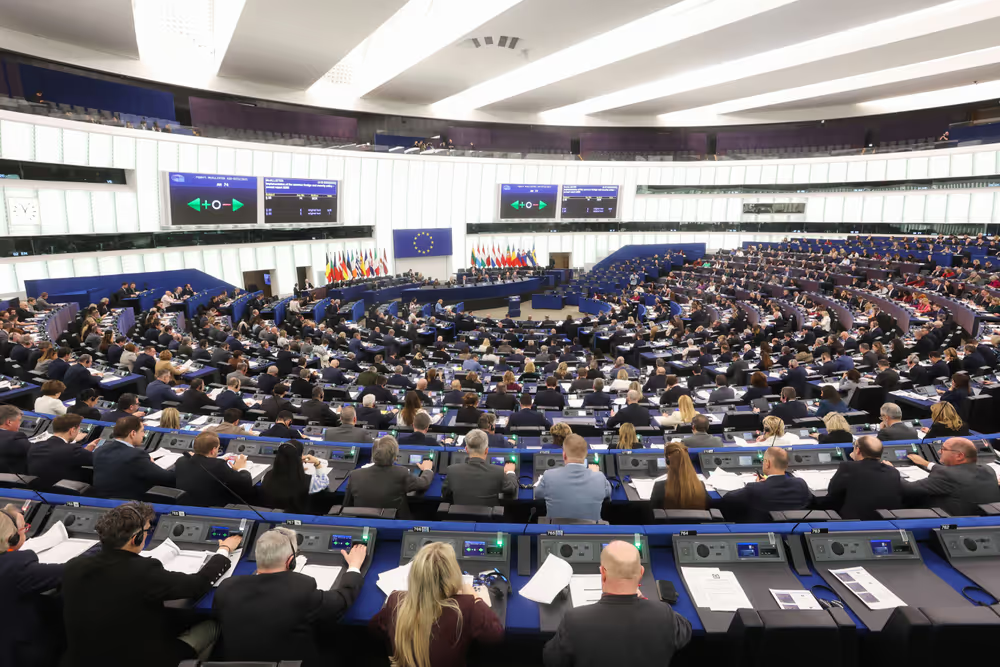
The European Parliament asks the EU Court of Justice to evaluate the agreement with Mercosur

Sursa foto: Parlamentul European

The European Parliament has requested the European Court of Justice to assess whether the trade agreement between the European Union and the Mercosur countries was signed in accordance with the community block treaties, reports IPN.

The request to the CJEU was made against the backdrop of protests by farmers from various states. They took to the streets in front of the European Parliament headquarters in Strasbourg, to put pressure on European lawmakers, who were about to vote on the agreement signed last week in Paraguay.

Due to the complaint, the entry into force of the agreement is blocked, theoretically speaking, but the European Commission has the possibility to implement the treaty, on a provisional basis.

According to the document, European states will be able to export automotive, chemical, and pharmaceutical products to Mercosur countries without additional taxes. In turn, Mercosur states will have preferential access to the European market for products such as soy, honey, and beef or poultry.


The European Parliament asks the EU Court of Justice to evaluate the agreement with Mercosur

The Ombudsman notes that at the Temporary Placement Center for Adults with Disabilities in Badiceni, systemic issues persist regarding the...

Acest material este disponibil doar pe bază de abonament.
Abonează-te pentru a avea acces la mai multe materiale și funcționalități exclusive!

0 FacebookTwitterPinterestEmail


The European Parliament asks the EU Court of Justice to evaluate the agreement with Mercosur

Sursa foto: Parlamentul European

The European Parliament has requested the European Court of Justice to assess whether the trade agreement between the European Union and the Mercosur countries was signed in accordance with the community block treaties, reports IPN.

The request to the CJEU was made against the backdrop of protests by farmers from various states. They took to the streets in front of the European Parliament headquarters in Strasbourg, to put pressure on European lawmakers, who were about to vote on the agreement signed last week in Paraguay.

Due to the complaint, the entry into force of the agreement is blocked, theoretically speaking, but the European Commission has the possibility to implement the treaty, on a provisional basis.

According to the document, European states will be able to export automotive, chemical, and pharmaceutical products to Mercosur countries without additional taxes. In turn, Mercosur states will have preferential access to the European market for products such as soy, honey, and beef or poultry.


The authorities have restricted the use of drinking water and surface water for non-essential activities, such as street washing or pool filling. Water will be prioritized for the essential needs of the population. The decisions were approved by the National Crisis Management Commission, against the backdrop of risks generated by the low level of water in the Dniester, reports IPN.

At the same time, the capture of water from the Dniester River and the irrigation of agricultural lands will be allowed exclusively during the night, between the hours of 09:00 PM and 06:00 AM, with priority for horticultural crops. The irrigation process will be monitored by the competent authorities, and in sectors where the water level will reach critical thresholds, the Ministry of Environment may temporarily suspend the captures.

To ensure the continuity of water supply, local authorities will activate reserve wells and, as appropriate, will use available funds to put them into operation. At the same time, public service operators will intensify the monitoring of water quality at the intake points designated for drinking water supply, through additional sampling and laboratory analysis.

According to the decision of the CNMC, Apa-Canal Chisinau, in coordination with the competent local and central authorities, will undertake the necessary measures to maintain the water supply of the city of Chisinau. Depending on the evolution of the situation, the General Inspectorate for Emergency Situations will prepare logistical capacities for the distribution of potable water using mobile cisterns in the affected localities.

Also, the Commission has decided to reduce by at least 20% the water consumption of industrial economic operators whose activities are not essential for food production, the medical sector, or public health.

0 FacebookTwitterPinterestEmail


1 IANUARIE, 2025
1 IANUARIE, 2025